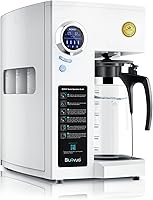
How Does a Countertop RO System Work?
A countertop RO system pushes tap water through a sediment filter, carbon filters, and a reverse osmosis membrane, then holds the clean water in a tank. A pump forces water across the membrane so contaminants are left behind and flushed to drain.
On this page (12 sections)
- What happens inside a countertop RO system?
- What does the sediment filter do first?
- How do the carbon stages work?
- How does the RO membrane actually clean water?
- What does the drain line carry away?
- How does the finished water get stored and poured?
- How do TDS meters help you track performance?
- Which countertop RO system should you pick?
- What maintenance does a countertop RO system need?
- Is RO water missing anything you want back?
- What about UV and extra protection stages?
- What should you know before you buy one?
A countertop reverse osmosis system works by pushing tap water through several filters in a row, with a reverse osmosis membrane at the center doing the heavy lifting. A pump forces water across that membrane, most dissolved contaminants stay behind, and the clean water collects in a tank you pour from.
Nothing gets plumbed in, which is the whole appeal. You fill a tank, plug the unit in, and it runs the stages on its own.
Here's how does a countertop RO system work, stage by stage.
What happens inside a countertop RO system?
Water moves through a sediment filter, carbon filters, the RO membrane, and often a polishing stage, in that order. A pump drives the flow, and a tank stores the finished water.
Each stage catches something different. Sediment holds grit, carbon handles chlorine and taste, and the membrane rejects the smallest dissolved particles, which is the part that makes the water taste clean.
The unit needs power for the pump and the controls. The AquaTru Classic, for example, runs on corded electric power and treats up to 500 ppm of incoming TDS.
What does the sediment filter do first?
The sediment stage traps sand, rust, and other solid bits before they reach the membrane. It's the cheapest filter in the chain and it protects everything behind it.
Without it, particles would clog the membrane's tiny pores. Keep a prefilter working and the expensive membrane lasts far longer.
This is a mechanical catch, not a chemical one. It doesn't remove chlorine or dissolved minerals, so the water feels and smells much the same after this step.
How do the carbon stages work?
Carbon filters absorb chlorine, many odors, and some organic compounds through their porous surface. Letting water sit against carbon pulls those materials out of the stream.
Most countertop units use two carbon stages, one before the membrane to protect it and one after to polish taste. The pre-carbon protects the membrane from chlorine, which can break it down over time.
The DREO RO 113 describes a 7-in-1 RO filter that reduces chlorine, fluoride, PFOA, and PFOS. The carbon stages are part of that chain, alongside the membrane.
How does the RO membrane actually clean water?
The membrane is a sheet with pores so small that water passes through but most dissolved contaminants can't. It's measured in fractions of a micron, tighter than any other filter in the unit.
Countertop systems usually use a pump to push water across the membrane, because household pressure from a tap isn't strong enough on its own. Forcing the water through leaves contaminants on the reject side.
The DREO RO 112 uses a 0.0001 μm membrane that reduces 99% of lead, chromium (hexavalent), chlorine, PFOS, and PFOA, plus 97% of fluoride, in lab conditions.
Why does reverse osmosis need a pump?
A pump gives the water enough pressure to cross the membrane quickly. Without one, output would be a slow drip and much of the water would stall at the surface.
This is why the units plug into a wall outlet. The pump, plus the TDS meter and controls, all run on electricity.
What does the drain line carry away?
The drain line flushes the rejected water, which holds the contaminants the membrane kept back. Without that flush, the membrane would foul and stop working.
This is called the pure-to-drain ratio, and it varies. DREO lists a 3:1 ratio on both of its models, so 3 parts clean water come out for every 1 sent away.
A low ratio means less water wasted per glass. Check this number if you care about utility use over a year of daily drinking.
How does the finished water get stored and poured?
Clean water flows into a storage tank, and you dispense it into a pitcher or glass from there. The tank is what lets you fill a bottle at once instead of waiting through each filter.
Some units include pitchers that refill automatically from the tank. The DREO RO 113 comes with two autofill pitchers, and the DREO RO 112 comes with one.
The AquaTru Classic holds 2.7 liters in a dispenser-style tank. Pick a tank size that matches how many people drink from it each day.
How do TDS meters help you track performance?
A TDS meter reads the total dissolved solids in your water, so you can compare raw tap water to the finished water. A big drop between the two means the membrane is doing its job.
Both DREO models display raw and pure water TDS in real time, plus a filter change reminder. That gives you a simple check without buying a separate meter.
The AquaTru Classic also reduces TDS, though it doesn't display a live reading on unit. If you want to watch numbers, add a hand-held meter.
Which countertop RO system should you pick?
Start with the AquaTru Classic if you want a long-proven brand with certified contaminant coverage. AquaTru says it is certified to meet NSF/ANSI standards 41, 53, 58, 401, and P473 for 84 contaminants, including PFOA, PFOS, and microplastics.
Its filters are rated for 600 to 1,200 gallons, which works out to a change every 6 months to 2 years. That long filter life keeps the ongoing cost low, and AquaTru says one set replaces 4,500 plastic bottles.
Now compare the countertop RO stage counts across the units you're weighing. More stages usually mean more protection for the membrane.
Who should choose the DREO RO 113?
Choose the RO 113 if you need more capacity for a busy kitchen. Its 5 liter tank plus two 1.1 liter autofill pitchers suits households of 3 to 4 people.
The 3:1 pure-to-drain ratio keeps wastewater down, and the filter lasts 265 gallons. DREO puts the footprint at about 14.5 by 6.7 inches, so it fits a standard counter.
Pick it over the smaller model when you fill a lot of glasses in a day and don't want to top up the tank often.
Who should choose the DREO RO 112?
Choose the RO 112 if you want the same filtration in a smaller package for 1 to 2 people. It has a 3 liter tank and one 1.1 liter pitcher.
It includes a self-cleaning system that auto-flushes the internal tubes, plus the same 3:1 ratio and 265 gallon filter life. The slim body is 14.5 by 6.7 inches.
Go with this one if counter space is tight and you don't need the extra pitchers.
What maintenance does a countertop RO system need?
Mostly you change filters and descale, and the unit's reminders tell you when. The work is quick because the filters twist out from the front.
Filter life varies by unit. A 265 gallon filter is about 6 months for most households, and AquaTru's set stretches to 2 years on the generous end.
Descaling removes mineral scale from the lines, and DREO sells a citric acid kit for the job. Follow the unit's own instructions so you don't damage the membrane.
To compare units side by side, see our picks for the best countertop RO systems. If you'd rather not pour from a plastic tank, look at glass countertop water filter options instead.
Is RO water missing anything you want back?
Yes, RO strips most dissolved minerals along with contaminants. Calcium and magnesium are the two people ask about most.
That's a real trade-off, not a flaw. If you want minerals back, you can add a remineralization cartridge or take them from food and supplements.
For the full picture, read whether reverse osmosis removes minerals and what to do about it.
What about UV and extra protection stages?
Some countertop RO systems add a UV stage after the membrane to treat the stored water. It doesn't filter, but it gives the tank another layer of protection.
UV is worth it if your clean water sits in the tank for hours and you want extra confidence. Otherwise, carbon polishing handles most taste issues.
See the countertop reverse osmosis system with UV options if this stage matters to you.
What should you know before you buy one?
The short answer on how does a countertop RO system work: it filters through sediment, carbon, and a membrane, pumps the clean water into a tank, and flushes the rest to drain. That's the whole process.
Match the tank size to your household. A 2.7 to 3 liter tank fits 1 to 2 people, while a 5 liter tank with two pitchers works better for 3 to 4.
Pick the AquaTru Classic for certified coverage and long filter life. Pick the DREO RO 113 for capacity, or the DREO RO 112 for a smaller footprint with self-cleaning.
Our overall pick for most homes is the DREO RO 113 for its 5 liter tank and live TDS readout. Choose by how many glasses you pour in a day, and the rest of the system will take care of itself.
Frequently asked questions
Can a countertop RO system work without electricity?
No. A countertop RO system needs power for its pump and controls, so it plugs into a wall outlet.
A manual gravity filter is the option when you have no outlet nearby.
Where does the wastewater go?
The drain line carries the concentrated rejected water to your sink. DREO lists a 3:1 pure-to-drain ratio, so about 3 cups of clean water come out for every cup sent away.
How often do the filters need changing?
AquaTru says its filter set lasts 600 to 1,200 gallons, or roughly every 6 months to 2 years. DREO lists a 265 gallon filter life, about 6 months, with a change reminder on the unit.
Does the water taste different after reverse osmosis?
Most people notice a cleaner, flatter taste because chlorine and dissolved solids are reduced. Some miss the minerals, which is why remineralization is a common follow-up topic.
Can I use a countertop RO system in a rental?
Yes. These units sit on the counter and need no plumbing work, so nothing is drilled or unscrewed.
You fill the tank by hand or from a pitcher and unplug it when you move.