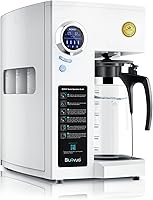
9 Best Countertop RO Systems With UV (November 2026)
The best countertop reverse osmosis systems with UV include the Waterdrop G3P600 (best overall), the iSpring RO5004F-AK (best with built-in uv), and the DREO 3:1 Countertop RO (best no-install countertop).
On this page (5 sections)
The best countertop reverse osmosis system with UV for most kitchens is the Waterdrop G3P600, thanks to its 8-stage filtration, smart display faucet and 2:1 pure-to-drain ratio. If you want the UV lamp built into the unit itself, the iSpring RO5004F-AK adds a mineral stage and a pump for low water pressure.
For a true plug-and-play unit that sits on the counter, the DREO 3:1 is the easiest to live with.
A UV stage is the extra you're shopping for, so this list puts the models with a real UV or disinfection step near the top. Some units here, like the Waterdrop G3P600, skip UV but win on filtration depth and smart monitoring.
That's a fair trade if your main worry is lead, PFAS and TDS rather than microbes.
Our picks at a glance
-
1

-
2

-
3

How we compared these countertop RO systems with UV
We started with the systems that name UV light in their filtration path or offer it as a built-in stage. That narrowed the field before we looked at anything else.
From there we weighed five things: how many filtration stages each system runs, whether the UV lamp is inside the unit or absent, the pure-to-drain ratio, the water tank or pitcher size, and how much counter or cabinet space it needs. A 4:1 ratio wastes less water than a 2:1 one, so that counted in a system's favor.
We also looked at what the display tells you. A system that shows TDS and filter life, like the Waterdrop G3P600 or VonWater CT910G, is easier to keep on schedule than one with a simple indicator light.
The Bluevua and Purevua units also track filter life, while the DREO pairs its TDS meter with a change indicator.
Scores combine those specs with how well each unit fits a real kitchen: a renter who can't drill gets more value from a countertop model than from an under-sink one. Our score weighs specs, features and buyer feedback against what you're shopping for.
These are the best countertop reverse osmosis systems with UV
The Waterdrop G3P600 takes the top spot on filtration depth and monitoring, while the UV-equipped picks each suit a different kitchen. Read each write-up for the job it does best.
Waterdrop G3P600: Best overall
- 8-stage filtration
- 2:1 pure to drain
- Smart display faucet with TDS monitor
- Tankless under-sink design
Eight filtration stages and a faucet that shows TDS and filter life make this the strongest all-around pick for a kitchen that can take an under-sink unit.
Pros
- NSF/ANSI 58, 42 and 372 certified
- Fills an 8 oz cup in 8 seconds
- Tankless cabinet frees about 70% of space
Cons
- Needs an under-sink power outlet
- Cabinet must fit 18.12 x 5.67 x 17.72 in
Waterdrop's G3P600 is an under-sink tankless system rather than a countertop box, and it earns the top score on sheer filtration. It runs 8 stages and Waterdrop says third-party lab tests show reductions in TDS, chromium, PFAS, radium, fluoride and arsenic.
The brand also cites reductions in vinyl chloride and other chemicals named in its membrane technical manual.
The smart display faucet is the part you'll notice daily. It shows the TDS of your filtered water and tracks how much filter life is left, so you're not guessing when to reorder.
The silver faucet is metal, while the system cover is plastic.
Its 2:1 pure-to-drain ratio means one cup of waste for every two cups of pure water, and it fills an 8 oz cup in 8 seconds. The tankless cabinet design frees about 70% of the under-sink space a tank model would use, and a filter change takes seconds without tools or moving the unit.
Waterdrop also lists an automatic flushing function that keeps water fresh when the system sits unused. An internal shelf life of 24 months applies to the product, so note the date on the box.
This is the best pick if you have an outlet under the sink and want the deepest filtration here. The trade-off is no UV stage: if microbe protection is your reason for shopping, go with the iSpring below.
Measure your cabinet against the 18.12 x 5.67 x 17.72 in body first, and note the install needs two drilled holes, one for the faucet and one for the drain line.
iSpring RO5004F-AK: Best with built-in UV
- Built-in UV light rated to 8,000 hours
- Mineral boost stage
- 500 gallons per day
- Built-in pump for low pressure
The UV lamp sits inside the system and runs alongside a mineral stage, so you get disinfection and a softer taste from one under-sink box.
Pros
- UV light with filter lifespan monitoring
- SGS tested for PFAS and TDS reduction
- Built-in pump helps low water pressure
Cons
- Still an under-sink install
- Mineral stage adds a filter to replace
The iSpring RO5004F-AK is the best system here with a UV lamp built into the unit. The light lasts up to 8,000 hours and the system monitors its lifespan, so replacement isn't a surprise. iSpring cites 20 years in the water treatment industry as backing for its replacement filter range.
It's also the only under-sink pick that puts minerals back. The AK stage adds calcium, magnesium and other minerals after the RO membrane, which gives the water a spring-like taste and a balanced pH.
Water quality claims are specific: iSpring says SGS tested it for PFAS and TDS reduction and that it removes over 99% of 1,000+ contaminants. The built-in pump keeps output steady in low-pressure homes, and 500 gallons a day fills a cup in about 10 seconds.
Quiet operation is part of the design, with a casing meant to keep the pump hum down.
The top-mounted fastener means you can install it from above the counter without reaching underneath. That's a real help if your cabinet is cramped.
Choose it for UV plus remineralization in one box. The downside is one more filter to replace when the mineral stage wears out.
The four replacement filters are named in the listing as FP500, FC500SL, MRO5004F and FG500AK, so note those codes.
DREO 3:1 Countertop RO: Best no-install countertop
- 7-in-1 RO filtration
- Two autofill pitchers
- 5 liter capacity
- Self-cleaning cycle
A plug-in unit that needs no plumbing and ships with two pitchers, so you can keep one chilling while the other fills.
Pros
- SGS tested to NSF/ANSI 58 standards
- Two pitchers double your ready supply
- TDS meter and filter change indicator
Cons
- Takes up counter space
- 5 liter tank needs regular refills
DREO's unit is the best true countertop pick. It sits on your counter, plugs in and needs no plumbing or drilling, which makes it the right choice for renters and anyone who can't cut into a cabinet.
It runs 7 stages and DREO says SGS tested it to NSF/ANSI 58 standards for removal of 99.9% of contaminants including PFOA, PFOS, chlorine and fluoride. The 3:1 pure-to-drain ratio is better than most under-sink systems here.
The cabinet is ABS plastic and the unit weighs 10.8 pounds, so it lifts easily when you need to clean under it.
The 5 liter tank feeds two autofill pitchers, so one can chill in the fridge while the other fills. A built-in TDS meter and a filter change indicator keep you informed, and the touch controls handle a self-cleaning cycle so you're not scrubbing parts by hand.
Replacement filters and a citric acid descaling kit are sold separately, so plan for the descaling step as well as the filter change.
Pick this if you want no-install convenience and a spare pitcher ready to pour. The trade-off is counter space: it's a 15.7 x 6.7 x 13.4 in footprint, and the tank needs refilling more often in a big household.
Note that this unit has no UV stage, so pair it with a filter schedule you'll actually keep.
Waterdrop KJ600: Best for hot drinks

- Heating plus cold dispensing
- 104 F to 203 F temperature range
- 5-stage filtration
- Child lock on the faucet
This is an RO system with a heater built in, so it pours hot water for tea or oatmeal from the same faucet that gives you cold drinking water.
Pros
- Adjustable heat up to 203 F
- Heating overtime protection
- TDS and filter status on the faucet
Cons
- Heating mode takes time to reach temperature
- Costs more than a cold-only system
Waterdrop's KJ600 is the best pick if you want hot water from your RO system. It dispenses cold and hot water from the same smart faucet, with adjustable heat from 104 F to 203 F.
Waterdrop lists it as the first-to-market RO system with a heating function.
The 5-stage filtration reduces TDS, PFOA, PFOS, fluoride, arsenic, nitrate, lead and mercury. Heating happens in an internal tank, and Waterdrop says it takes about 15 minutes to go from room temperature to 203 F.
The faucet shows the set temperature so you can see when it's ready.
Safety features matter with hot water: there's a child lock on the faucet, plus a flow meter, NTC sensor and heating overtime protection to prevent dry burning. Hot steam drains through the drain pipe rather than into the cabinet, and insulation cotton guards against scalding.
The faucet is stainless steel with a bright nickel finish, and the tubing is rated to 500 F.
Its 2:1 pure-to-drain ratio and 600 gallons a day match the G3P600's output. The system can take Waterdrop's MNR remineralization filter, but only on the cold line, and it can't feed a fridge or ice maker.
Buy it for tea, coffee and oatmeal without a kettle. The trade-off is that heating mode needs time and a dedicated outlet; Waterdrop recommends a separate socket and lists a 7A current draw.
It also costs more than a cold-only system.
AquaTru Glass Carafe: Best for glass-first kitchens

- 4-stage RO with alkaline mineral boost
- Borosilicate glass carafe
- IAPMO tested to NSF standards
- No plumbing or drilling
The filtered water lands in a glass carafe rather than a plastic tank, which suits anyone who wants to avoid plastic in contact with drinking water.
Pros
- Removes 84 contaminants including PFOA and PFOS
- Adds calcium and magnesium back
- Glass carafe for storage
Cons
- Small clean water tank
- Filters run on separate replacement schedules
AquaTru's Glass Carafe is the best pick for a glass-first kitchen. Filtered water drops into a borosilicate glass carafe with a lid rather than a plastic tank, so nothing plastic touches your drinking water after filtration.
The 4-stage system removes 84 contaminants including PFOA, PFOS, lead and microplastics, and AquaTru says IAPMO tested it to NSF standards. The alkaline stage adds calcium, magnesium, potassium and sodium back for a mineral-rich taste.
The standard model uses a plain VOC filter without those minerals.
There's no plumbing or drilling: fill the 0.66 gallon tap tank and the unit dispenses into the 64 oz glass carafe. It plugs into a standard outlet and sits on the counter, measuring 13 x 14 x 7.5 in.
Built-in filter indicators flag each stage when it's due.
Choose it if glass storage and an alkaline boost matter more than tank size. The trade-off is capacity: the 0.5 gallon clean tank is smaller than the DREO's pitchers, so a family will refill more often.
The filters also run on separate schedules, with the pre-filter and alkaline stage both due around the 6-month or 300-gallon mark.
For more on what RO takes out of water, see does reverse osmosis remove minerals.
Bluevua RO100ROPOT: Best for a spare carafe

- 6-stage filtration with UV light
- Two borosilicate glass carafes
- Remineralization stage
- 2:1 pure to drain
The bundle includes an extra replacement carafe, so one can sit in the fridge while the other is being filled on the counter.
Pros
- UV light in the filtration path
- Two glass carafes included
- Low power standby mode
Cons
- Large footprint on the counter
- Carafes are glass and need careful handling
The Bluevua RO100ROPOT is the best pick if you want a spare carafe in the box. The bundle includes a second borosilicate glass carafe, so you can keep one full in the fridge while the other fills on the counter.
Its 6-stage filtration pairs a 0.0001μm RO membrane with a UV light and a remineralization stage. Bluevua says it reduces TDS, PFOA, PFOS, chlorine, fluoride, arsenic and lead, then adds essential minerals back.
The glass carafe is there to prevent secondary pollution after the water leaves the filter.
The unit needs no plumbing or installation. A 2:1 pure-to-drain ratio keeps waste reasonable, and it drops to a power-saving standby mode when idle.
An LED display tracks filter life and water quality. Bluevua also holds a ClimatePartner certification and pitches the unit as a way to cut bottled water.
Pick this for a two-carafe routine and UV disinfection in a countertop unit. The trade-off is footprint: two glass carafes plus the unit take up real counter space, and glass needs careful handling.
The product listing gives no dimensions for this model, so measure the space you have before ordering.
It also offers less smart monitoring than the Waterdrop faucet systems. Compare more glass options in our guide to the best countertop water filters with a glass pitcher.
Natureflow Countertop RO: Best for mineral-rich water

- 10-stage RO with mineralization
- 4:1 pure to drain
- 5 liter capacity
- Child safety lock
A 10-stage countertop unit that puts minerals back and wastes less water than most RO systems, with a 4:1 pure-to-drain ratio.
Pros
- SGS certified to NSF/ANSI 58
- Weak alkaline mineral water around pH 9.0 to 9.5
- Rotating display screen
Cons
- Bulky at 18.5 x 8.58 x 13.9 in
- Mineral claims go beyond taste for some buyers
Natureflow's F40 SE is the best pick if you want mineral-rich water and low waste. It runs 10 stages, and Natureflow says SGS certified it to NSF/ANSI 58 and UL safety standards.
The 0.0001μm membrane and three-cartridge setup do the purification work.
The mineral stage is the headline: it restores potassium, calcium, sodium, magnesium, strontium and metasilicic acid, producing weak alkaline water in the pH 9.0 to 9.5 range. Natureflow describes this as mimicking how spring water forms naturally, without adding chemicals.
Water efficiency is the other strong point. A 4:1 pure-to-drain ratio is the best here, and Natureflow says the filtration set lasts 2 to 4 years.
That's longer than most rivals, and the brand ties it to replacing up to 12,000 bottles of water over time.
The digital display tracks temperature, volume, filter lifespan and cleaning cycles, and there's a child safety lock plus an automatic cleaning function. The screen rotates for easier reading at different angles.
Choose it for mineral taste and water savings in a 5 liter countertop tank. The trade-off is size: at 18.5 x 8.58 x 13.9 in it's the bulkiest countertop model here, so measure your counter before ordering.
Its alkaline claims are also the strongest in this group, so treat the pH promise as a taste preference rather than a health need.
Purevua PR1-A: Best for small spaces

- 6-stage filtration with UV light
- Borosilicate glass pitcher
- 68 fl oz per cycle
- 3:1 pure to drain
A compact plug-in RO dispenser that fills its glass pitcher in one cycle, which helps when counter space is tight.
Pros
- FCC certified and SGS tested
- Meets NSF/ANSI/CAN 372 lead-free standard
- Enlarged icons suit older users
Cons
- Needs 18 in of vertical clearance
- Pitcher holds less than a full-day supply for a family
The Purevua PR1-A is the best pick when counter space is tight. It's a compact countertop dispenser that fills its 68 fl oz glass pitcher in one cycle, so you're not waiting through several small pours.
Its 6-stage filtration ends with a UV light. Purevua says the system is FCC certified and SGS tested, meets the NSF/ANSI/CAN 372 lead-free standard, and reduces TDS to within 10 PPM.
It also removes chlorine, fluoride, arsenic, lead, PFOA and PFOS. All water-contact parts are BPA-free, and the pitcher is heat and cold resistant.
The interface is built for easy reading, with enlarged icons and text. Most functions run automatically: TDS detection, filter flushing, UV activation, sleep mode, filter life reminders and a low water level alert.
You choose start and stop or one of three volume settings. A 3:1 pure-to-drain ratio beats most under-sink RO systems.
The pitcher lid has a guided-flow channel to cut the dripping noise as it fills.
Buy it for a small kitchen, an apartment or an RV. The trade-off is vertical clearance: Purevua asks for at least 18 inches so you can lift the tank out.
The pitcher also holds less than a full day's supply for a large family.
Replacement filters run about 6 months for the CF stage and 12 months for the RO stage. Purevua also notes that a little water mist inside a new unit is normal after factory testing.
VonWater CT910G: Best for big households

- 7-stage filtration with LED purification
- 5.5 liter feed tank
- 1.2 liter autofill pitcher
- 5 volume options
The largest feed tank here, plus a removable pitcher you can chill, makes this the pick for a busy family counter.
Pros
- Meets NSF/ANSI 372, 42 and 58
- Real-time TDS and filter life display
- Plug and use with no install
Cons
- Largest unit here at 13.4 x 8.2 x 15.3 in
- Replacement filter search uses a model code
VonWater's CT910G is the best pick for a big household. It has the largest feed tank here at 5.5 liters, plus a removable 1.2 liter pitcher you can store in the fridge for chilled water.
The 7-stage filtration includes LED light purification. VonWater says third-party labs tested it to NSF/ANSI 372, 42 and 58 standards, with reductions in TDS, PFAS, heavy metals, chlorine and fluoride.
The materials are BPA-free and lead-free. The brand rates the composite filter for up to 2 years and 528 gallons.
A real-time LED touch screen shows TDS and filter life. Five volume options run from 5 oz to unlimited dispensing, which helps when you're filling a pot rather than a glass.
The 3:1 pure-to-drain ratio saves water compared with 2:1 systems. A removable pitcher you can watch fill from three angles makes it easy to see when the water is ready.
It's plug and use, with no installation, so it suits renters and seniors. Choose it for the largest water supply on a counter.
The trade-off is its size: at 13.4 x 8.2 x 15.3 in it's the biggest countertop model here, and VonWater asks you to drain the wastewater before each refill. VonWater also lists the replacement filter under the code CT100-RO, so note that before you need one.
For under-sink alternatives, see our roundup of the best countertop RO systems.
How these countertop RO systems compare side by side
UV placement and install type separate these systems more than filtration stage counts do. The table puts the key differences in one place.
| Product | Best for | Installation | Capacity | Pure to drain | Our score |
|---|---|---|---|---|---|
| Waterdrop G3P600 | overall | Under sink | 600 gallons per day | 2:1 | 9.6 |
| iSpring RO5004F-AK | with built-in UV | Under sink | 500 gallons per day | 2:1 | 9.4 |
| DREO 3:1 Countertop RO | no-install countertop | Countertop | 5 liters | 3:1 | 9.0 |
| Waterdrop KJ600 | hot drinks | Under sink | 600 gallons per day | 2:1 | 8.6 |
| AquaTru Glass Carafe | glass-first kitchens | Countertop | 0.5 gallon clean tank | Not given | 8.4 |
| Bluevua RO100ROPOT | a spare carafe | Countertop | Two carafes | 2:1 | 8.3 |
| Natureflow Countertop RO | mineral-rich water | Countertop | 5 liters | 4:1 | 8.2 |
| Purevua PR1-A | small spaces | Countertop | 68 fl oz | 3:1 | 8.1 |
| VonWater CT910G | big households | Countertop | 528 gallons | 3:1 | 8.0 |
What should you check before buying a countertop RO system with UV?
Check three things first: whether the unit sits on the counter or under the sink, whether UV is built in or absent, and how much water the tank holds. Everything else is secondary.
Countertop or under-sink?
Countertop models like the DREO, Purevua and VonWater need no plumbing and no drilling. You fill a tank by hand and the unit makes purified water on the spot.
They suit renters, apartments and anyone who won't cut into a cabinet. Most run on a standard outlet and can move with you if you relocate.
Under-sink systems like the Waterdrop G3P600, iSpring RO5004F-AK and Waterdrop KJ600 connect to your water line and need an electrical outlet in the cabinet. They free your counter and give you water on tap without refilling.
The Waterdrop G3P600 needs two drilled holes, one for the faucet and one for the drain line.
The trade-off is real in both directions. Under-sink units need installation work and cabinet space.
Countertop units need refilling and a spot on your counter. A countertop unit also puts the tank and pitcher in view, so measure the footprint and any clearance the brand asks for.
Is UV actually in the unit?
Check where the UV lamp sits. Some systems name UV as a stage in the filtration path, like the iSpring RO5004F-AK, Bluevua RO100ROPOT and Purevua PR1-A.
Others here, including the Waterdrop G3P600 and DREO, rely on RO filtration alone.
If your water comes from a private well or a source you don't fully trust, UV is worth having as a final barrier. For treated municipal water, the RO membrane already handles most of what you're worried about.
Either way, UV does not remove dissolved solids, so the RO stage still does the heavy lifting on lead, PFAS and TDS.
How much water do you need each day?
A family of four drinks more than a single person, and countertop tanks show it. The VonWater's 5.5 liter tank and 1.2 liter pitcher suit a busy kitchen.
The Purevua's 68 fl oz pitcher covers a couple comfortably.
Under-sink units rated at 500 to 600 gallons a day give near-unlimited supply. That's the main reason to pick one if you cook and fill pots often.
The iSpring and both Waterdrop systems list 500 and 600 gallons a day respectively.
What do you want the display to tell you?
The most useful displays show TDS and filter life. The Waterdrop G3P600 and KJ600 both put that on the faucet.
The VonWater CT910G does it on a touch screen. The DREO adds a filter change indicator, and the Bluevua and Purevua units track filter life too.
A TDS reading tells you how well the membrane is working. A filter life tracker tells you when to spend money.
A system with both is easier to keep healthy than one with a single warning light. Some units also offer a filter reset, so you can clear the reminder after a change.
How much waste water can you accept?
Pure-to-drain ratios here run from 2:1 to 4:1. The 2:1 units make one cup of waste for every two cups of pure water.
The 4:1 Natureflow wastes a quarter as much per cup.
If you're on a metered water bill or care about waste, go for 3:1 or 4:1. The Waterdrop G3P600 and iSpring sit at 2:1, while the DREO, Purevua and VonWater reach 3:1 and the Natureflow hits 4:1.
The AquaTru listing does not give a ratio, so ask the brand if waste matters to you. A lower ratio is the price you pay for other features on some units.
Which countertop reverse osmosis system with UV should you buy?
The Waterdrop G3P600 remains the best pick for most kitchens because it offers the deepest filtration and the clearest daily feedback of any system here. Pick the iSpring RO5004F-AK when a built-in UV lamp and a mineral stage matter more than the Waterdrop's stage count.
The DREO 3:1 is the one to buy if you want a countertop unit with no plumbing at all and two pitchers to rotate.
The rest are best for specific situations. The AquaTru Glass Carafe suits a glass-first kitchen, the Bluevua RO100ROPOT gives you a spare carafe, and the Natureflow wins on water savings.
The Purevua PR1-A is the compact choice, the VonWater CT910G is the large-household pick, and the Waterdrop KJ600 is the only one that pours hot water.
If you want the broader field first, start with our guide to the best countertop reverse osmosis water system and work back to the UV question from there. Either way, measure your space, confirm the UV placement and check the filter replacement schedule before you commit.
Our top 3 picks at a glance
-
1
-
2
-
3
Frequently asked questions
Does a UV light in an RO system make the water safer?
UV light adds a disinfection step, but RO filtration already removes most contaminants. The two work together: RO takes out dissolved solids and particles, and UV targets microbes in the water that reaches the lamp.
Treat UV as an extra layer, not a replacement for changing filters on schedule.
Do all countertop RO systems with UV need a power outlet?
Yes. Every model here plugs into a standard outlet, because the RO pump and the UV lamp both need power.
An under-sink unit like the Waterdrop G3P600 or iSpring RO5004F-AK also needs electricity, so check for an outlet in the cabinet before you buy.
How often do UV lamps in RO systems need replacing?
It depends on the model. iSpring says its UV light lasts up to 8,000 hours, and the system tracks the lifespan for you.
Most units tie the UV lamp to a filter stage, so follow the replacement reminder on the display or faucet.
Can a countertop RO system with UV fit in a small kitchen?
Yes, if you pick a compact model and measure first. The Purevua PR1-A needs about 18 inches of vertical clearance for its tank and controls.
The VonWater CT910G is the largest here, so leave room around it for the pitcher to fill and lift out.
Is UV needed if the RO membrane already filters the water?
The RO membrane handles dissolved contaminants like lead, PFAS and TDS. UV is aimed at living organisms, which is why some systems include it as a final stage.
If your tap water comes from a private well, the extra step is worth having.