7 Best Countertop Reverse Osmosis Water System (November 2026)
The best best countertop reverse osmosis water systems include the DREO Reverse Osmosis Water Filter Countertop for most kitchens, the Bluevua RO100ROPOT Countertop Reverse Osmosis Water Filter for glass carafe fans, and the AquaTru Glass Carafe for alkaline mineral water.
On this page (4 sections)
The best countertop reverse osmosis water system for most kitchens is the DREO Reverse Osmosis Water Filter Countertop, because its 3:1 pure-to-drain ratio and self-filling 3-liter pitcher make daily use easy. Pick the Bluevua RO100ROPOT if you want a glass carafe, or the VonWater CT910GH if you also want instant hot water.
These units sit on the counter, plug into a wall outlet and take tap water straight from the tank. No plumbing, no drilling and no under-sink space needed.
That makes them a good fit for renters and small kitchens.
The trade-off is speed and tank size: a countertop unit makes water in batches rather than on demand like a faucet filter. Our plain guide to countertop water filter systems covers how these units differ from pitchers and under-sink models.
If you already know you want a glass carafe, our roundup of glass countertop water filters narrows the field further.
Our picks at a glance
-
1
 Best for most kitchens
DREO Reverse Osmosis Water Filter Countertop
9.5/10 our score
See it on Amazon -
2
 Best for glass carafe fans
Bluevua RO100ROPOT Countertop Reverse Osmosis Water Filter
8.8/10 our score
See it on Amazon -
3

- 4
 Check it
Natureflow Countertop Reverse Osmosis Water Filter System
Best for large households - 5
 Check it
Purevua PR1-A Countertop UV Reverse Osmosis Water
Best for renters and small spaces - 6
 Check it
Express Water Countertop Reverse Osmosis Water Filtration
Best for tight budgets - 7
 Check it
VonWater CT910GH Reverse Osmosis Water Filter Countertop
Best for tea and coffee drinkers
Which countertop RO system fits your kitchen?
Start with how much water your household drinks in a day and where the unit will sit. The picks here split into big-tank units for families, glass-carafe models for taste-focused buyers, and compact or faucet-fed units for small spaces.
The score weighs specs, features and how well each unit matches what most buyers of a countertop RO system need.
| Product | Best for | Capacity | Size (L x W x H) | Filter life | Our score |
|---|---|---|---|---|---|
| DREO Reverse Osmosis Water Filter Countertop | most kitchens | 3 liters | 14.5 x 6.7 x 13.4 in | 6 months | 9.5 |
| Bluevua RO100ROPOT Countertop Reverse Osmosis Water Filter | glass carafe fans | 1700 ml | 10.9 x 15.4 x 14.3 in | 12 months | 8.8 |
| AquaTru Glass Carafe | alkaline mineral water | 0.5 gallons clean | 14 x 7.5 x 13 in | 1 year | 8.4 |
| Natureflow Countertop Reverse Osmosis Water Filter System | large households | 5 liters | 18.5 x 8.58 x 13.9 in | 2 years | 8.2 |
| Purevua PR1-A Countertop UV Reverse Osmosis Water | renters and small spaces | 68 fl oz | 17.09 x 6.97 x 14.21 in | 6 months | 8.1 |
| Express Water Countertop Reverse Osmosis Water Filtration | tight budgets | 12 gallons per day | 13.25 x 6.5 x 14 in | 6 months | 8.0 |
| VonWater CT910GH Reverse Osmosis Water Filter Countertop | tea and coffee drinkers | 5.5 liters feed | 13.4 x 8.2 x 15.3 in | 18 months | 7.9 |
How we compared these systems
We compared the systems on filtration stages, certifications, pure-to-drain ratio, tank size, filter life and counter footprint. We also weighed the pitcher or carafe material, since glass keeps purified water out of plastic.
Scores reflect how well each unit fits a typical kitchen rather than lab performance. A 9.5 means few trade-offs for most buyers, while lower scores point to a narrower fit or a real compromise on water waste, speed or tank size.
The best countertop reverse osmosis water systems
DREO Reverse Osmosis Water Filter Countertop: Best for most kitchens
DREO Reverse Osmosis Water Filter Countertop: Best for most kitchens
- 3:1 pure-to-drain ratio
- 3-liter autofill pitcher
- Built-in TDS meter and filter life display
- SGS tested to NSF/ANSI 58
A 7-in-1 RO system with a pitcher that fills itself, so you pour without waiting on a cycle. The 3:1 ratio wastes less water than most countertop units.
Pros
- Efficient 3:1 pure-to-drain ratio
- Autofill pitcher for pour-and-go use
- Built-in TDS meter
Cons
- Plastic pitcher, not glass
- 6-month filter change
The DREO suits a kitchen that wants purified water without thinking about it. Its 3-liter autofill pitcher fills itself after each cycle, so you can pour a glass whenever you walk past.
DREO says the 7-in-1 filter removes 99.9% of contaminants including PFOA, PFOS, chlorine and fluoride, and that SGS tested it to NSF/ANSI 58. A built-in TDS meter and filter life display sit on the front, so you can see water quality without a separate test pen.
The touch controls keep the whole thing to a press or two. It accepts source water up to 1200 ppm TDS, which covers most municipal supplies and many well systems that would clog a weaker unit.
The body measures 14.5 by 6.7 by 13.4 inches and weighs 9.5 pounds, so one person can lift it off the counter to wipe underneath. It arrives with the RO filter and pitcher already in the box, so there's no separate first order.
The 3:1 pure-to-drain ratio is the standout spec here. For every 3 gallons of purified water, 1 gallon goes to drain, which is better than most units in this group.
The 6-month filter life is the shortest part of the package, so plan for a replacement twice a year.
Choose it if you want the least fuss and the least water waste. Its main trade-off is the plastic pitcher: buyers who want glass should look at the Bluevua or AquaTru instead.
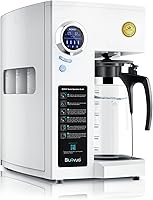
Bluevua RO100ROPOT Countertop Reverse Osmosis Water Filter: Best for glass carafe fans
Bluevua RO100ROPOT Countertop Reverse Osmosis Water Filter: Best for glass carafe fans
- 6-stage filtration with UV light
- Borosilicate glass carafe
- Remineralization filter
- 2:1 pure-to-drain ratio
A glass carafe keeps purified water out of plastic, and the mineral filter puts some taste back. The 2:1 ratio uses more water per liter than the DREO.
Pros
- Glass carafe for storage
- UV stage plus remineralization
- Filters rated for 12 months
Cons
- Uses more water per liter than the DREO
- Heavier at 17.8 lb
The Bluevua suits anyone who dislikes storing drinking water in plastic. Its container is a borosilicate glass carafe, and the sixth filtration stage adds minerals back after the RO membrane strips them out.
The 6-stage system includes UV light and a 0.0001μm RO membrane. Bluevua says the unit is certified by WQA against NSF/ANSI/CAN 372 for lead-free materials and tested by SGS for reductions including lead, arsenic, fluoride and PFOA.
The mineral filter is the reason the water doesn't taste flat. The kit ships with four filters plus the mineral cartridge, a cleaning brush and the power adapter, so the first year is covered before you buy a refill.
Filter life runs 12 to 24 months according to Bluevua, and the display tracks both filter life and water quality. The unit also drops into a power-saving standby mode between uses.
Bluevua notes that leftover water from a cycle isn't treated as wastewater, so it can be reused for plants or rinsing rather than poured down the drain. It holds 1700 ml and lists a maximum source TDS of 500 ppm, which is worth checking against your supply before you buy.
The 0.26 liter per minute flow rate means a carafe takes a few minutes to fill.
Its 2:1 pure-to-drain ratio uses more water than the DREO's 3:1, so it's a weaker pick if water waste matters most to you. At 17.8 lb it's also heavier to move for cleaning.
The 500 ppm ceiling is the bigger limit for hard or mineral-heavy water.
Pick it for glass storage and a mineral taste. Skip it if efficiency and light weight come first.
AquaTru Glass Carafe: Best for alkaline mineral water
AquaTru Glass Carafe: Best for alkaline mineral water
- 4-stage RO with alkaline mineral boost
- Borosilicate glass carafe with lid
- IAPMO tested to NSF standards
- Rated for 84 contaminants
The alkaline stage adds calcium and magnesium after filtration. A glass carafe with a lid lets you chill the water in the fridge without a separate jug.
Pros
- Alkaline mineral stage
- Glass carafe with lid
- Removable carafe goes in the fridge
Cons
- Alkaline water is a taste choice, not a safety need
- Smaller clean water tank than the DREO
The AquaTru suits buyers who want a mineral-rich taste and a carafe they can chill. Its 4-stage RO system ends with a VOC carbon filter that adds alkaline minerals, so the water picks up calcium and magnesium rather than coming out flat.
AquaTru says the system reduces 84 contaminants including microplastics, arsenic and PFOA/PFOS, and that IAPMO tested it to NSF standards. The 64 oz glass carafe has a lid and lifts out, so you can carry it to the fridge or the table.
The tap tank holds 0.66 gallons (2.5 liters) and the clean tank holds 0.5 gallons (1.9 liters), so the unit holds a decent reserve between cycles without a huge footprint. It measures 14 by 7.5 by 13 inches and weighs about 9 pounds.
The 0.5 gpm flow rate is faster than the Bluevua's trickle. It runs on a 120-volt wall plug and accepts source water up to 600 ppm TDS.
Filter life is split across three cartridges: the pre/carbon filter lasts 6 months or 300 gallons, the RO filter 1 year or 600 gallons, and the alkaline filter 1 year or 300 gallons. Built-in indicators tell you when each one is due.
The standard model uses the same body without the mineral stage, so the difference between the two is just that final filter.
The alkaline stage is a taste choice, not a safety requirement. If you just want clean water and don't care about mineral content, the DREO covers the same ground with less to replace.
Choose the AquaTru when alkaline water is the point.
Natureflow Countertop Reverse Osmosis Water Filter System: Best for large households
Natureflow Countertop Reverse Osmosis Water Filter System: Best for large households
- 5-liter tank
- 10-stage filtration with mineralization
- 4:1 pure-to-drain ratio
- Digital display with child lock
The biggest tank here means fewer refills for a family. A 4:1 ratio and a 2-year filter life keep running costs and water waste low.
Pros
- Largest tank in this group
- Most efficient ratio at 4:1
- Child safety lock
Cons
- Longest footprint at 18.5 in
- Mineral boost is a taste preference
The Natureflow suits a family that empties a pitcher fast. Its 5-liter tank is the largest here, so you fill it less often than the 3-liter DREO or the 1.7-liter Bluevua.
Natureflow says the 10-stage system uses a 0.0001μm RO membrane and three cartridges to remove up to 99.99% of contaminants including chlorine, lead, heavy metals and PFAS. It also claims a pH of 9.0 to 9.5 through a natural mineralization stage.
That stage restores potassium, calcium, sodium, magnesium and strontium, and Natureflow describes it as mimicking how spring water forms. Treat the mineral and pH claims as the maker's description, not a health guarantee.
The system is built without chemical scale inhibitors and claims to meet NSF/ANSI 58 and UL safety standards.
The 4:1 pure-to-drain ratio is the most efficient in this group. Filter life runs 2 to 4 years according to Natureflow, which spreads replacement cost over a long stretch.
A digital display tracks temperature, volume, filter life and cleaning cycles, and a child safety lock protects little hands. Automatic cleaning and water replacement reminders cut the manual upkeep.
The box includes a user manual with instructions for temperature selection, UV settings and dispensing. It measures 18.5 by 8.58 by 13.9 inches.
The trade-off is size: at 18.5 in long it takes the most counter depth here. Pick it when capacity and efficiency outweigh footprint.
Purevua PR1-A Countertop UV Reverse Osmosis Water: Best for renters and small spaces
Purevua PR1-A Countertop UV Reverse Osmosis Water: Best for renters and small spaces
- 6-stage filtration with UV light
- 68 fl oz glass pitcher
- 3:1 pure-to-drain ratio
- Auto TDS detection and flushing
One cycle fills the glass pitcher, so a single press covers a round of drinks. Automated flushing and UV keep maintenance simple for renters.
Pros
- Glass pitcher included
- One cycle fills the pitcher
- Automatic flushing and UV
Cons
- 6-month filter change
- Needs 18 in of vertical clearance
The Purevua suits renters and small kitchens that want glass without a big footprint. One cycle fills its 68 fl oz borosilicate glass pitcher, which covers several glasses or a pot of coffee in a single press.
The 6-stage system pairs an RO membrane with UV light, and Purevua says it removes 99.99% of more than 1,000 contaminants and brings tap water down to within 10 PPM TDS. It's tested to the NSF/ANSI/CAN 372 lead-free standard.
Three water levels (17, 34 and 68 fl oz) let you pick the pour size. Every water-contact part is BPA-free, including the tank, filters and tubing.
The pitcher is heat and cold resistant, so it can go in the fridge or hold warm water without cracking.
Automated flushing, UV activation and a sleep mode keep upkeep low. The pitcher lid has a guided-flow channel that sends water down the glass wall, which cuts the dripping noise some units make while filling.
A low water reminder tells you when to top up the source tank. The system measures 17.09 by 6.97 by 14.21 inches.
The 6-month filter life and the 18 in of vertical clearance for lifting the tank are the real limits. Purevua sells the CF and RO filters and a replacement pitcher separately, so parts are easy to source.
Choose it for glass storage in a tight space. Pick the DREO instead if you want an autofill pitcher and a longer filter interval.
Express Water Countertop Reverse Osmosis Water Filtration: Best for tight budgets
Express Water Countertop Reverse Osmosis Water Filtration: Best for tight budgets
- 4-stage RO filtration
- Hooks to a threaded faucet aerator
- No electricity needed
- Rated to NSF/ANSI 58
A faucet-fed unit with no pitcher and no power cord. It makes water slowly, but the setup is simple and the price tier is the lowest here.
Pros
- No electricity required
- Simple faucet connection
- Lowest price tier in this group
Cons
- Slow output at 0.5 to 1 gallon per hour
- Wastes 3 gallons per gallon purified
The Express Water suits a buyer who wants RO water at the lowest cost and doesn't mind waiting. It's a faucet-fed unit with no pitcher and no power cord, so it connects straight to a threaded faucet aerator and runs on water pressure.
The 4-stage system includes sediment, granular carbon, an RO membrane and post carbon. Express Water says it removes 99.99% of major contaminants and that an independent lab certified it to NSF standard 58.
It comes preassembled and installs in minutes with quick-connect tubing. The kit includes adapters for 13/16 inch male thread, 13/16 inch female thread and 15/16 inch female thread faucets.
The unit can sit freestanding or be wall mounted, and the replaceable cartridges swap out without tools. It measures 13.25 by 6.5 by 14 inches.
It accepts source water up to 2000 ppm TDS, the highest ceiling in this group, which suits well water that would overwhelm the other units.
The catch is speed: it filters 0.5 to 1 gallon per hour and has a 1:3 pure-to-drain ratio. That means 3 gallons go to drain for every gallon you drink.
It also only fits faucets with a removable threaded aerator, so check yours first. It needs 45 to 80 PSI of water pressure to work as intended, and only cold water should go in, since hot water damages the membrane.
Pick it if budget and a cord-free setup matter more than speed. Anyone who wants water on demand should look at the DREO or Purevua.
VonWater CT910GH Reverse Osmosis Water Filter Countertop: Best for tea and coffee drinkers
VonWater CT910GH Reverse Osmosis Water Filter Countertop: Best for tea and coffee drinkers
- 3-second instant heating
- 7-stage RO filtration
- 5.5-liter feed tank
- 3:1 pure-to-drain ratio
Instant hot water straight from the purifier suits tea, coffee and instant meals. The removable pitcher can go in the fridge for cold water too.
Pros
- Instant hot water on demand
- Removable pitcher for the fridge
- 18-month filter life
Cons
- Heating adds a feature some kitchens don't need
- Largest feed tank to fill
The VonWater suits a kitchen that wants hot water without a kettle. Its 3-second instant heating delivers hot RO water for tea, coffee or instant meals, and the 7-stage filtration includes an LED purification stage.
VonWater says the unit removes 99.99% of contaminants including PFAS, heavy metals, chlorine and fluoride, and that third-party labs tested it to NSF/ANSI 372, 42 and 58. The 5.5-liter feed tank is the biggest here, so it goes longer between fills.
It dispenses fast, filling a 5 oz cup in about 8 seconds, which matters more when you're waiting on hot water.
A removable 1.2-liter pitcher autofills and can be carried to the fridge for cold water. Five volume options run from 5 oz up to unlimited dispensing.
The 3:1 ratio matches the DREO, and VonWater rates the composite filter for up to 18 months or 528 gallons. The touch screen shows TDS and filter life in real time, and a red flashing light warns you before the filter expires.
It measures 13.4 by 8.2 by 15.3 inches and weighs 15 pounds. Replacement filters are easy to find by part number.
The heating feature is the trade-off: it adds cost and complexity for anyone who doesn't drink hot water at home. Choose it if hot water on tap is a daily habit.
Otherwise the DREO covers cold water with less machinery.
What to check before you buy a countertop RO system
Decide on tank size and water-waste ratio first, because those two specs shape how the unit fits your day. Everything else, from glass carafes to instant heating, is a preference on top.
How much water does your household drink?
Count the glasses, bottles and cooking water you use in a day. A couple may do fine with the Bluevua's 1700 ml carafe or the Purevua's 68 fl oz pitcher.
A family of four that cooks at home will refill those several times, so the Natureflow's 5-liter tank or the DREO's 3-liter autofill pitcher saves effort. Match the tank to your refill patience, not to the biggest number on the page.
The VonWater's 5.5-liter feed tank holds the most raw water, but its 1.2-liter pitcher is what actually pours, so read both numbers before you assume a big unit means big pours.
How much wastewater can you accept?
Check the pure-to-drain ratio on each model. The Natureflow at 4:1 and the DREO, Purevua and VonWater at 3:1 waste the least.
The Express Water at 1:3 sends 3 gallons to drain for each gallon purified. If you pay for municipal water or care about conservation, the efficient units pay off over years of use.
The Bluevua at 2:1 sits in the middle. One more factor: some makers say leftover water from a cycle can be reused on plants rather than dumped, so a lower ratio isn't always pure loss.
Do you want glass or plastic for storage?
Glass carafes keep purified water out of plastic and don't hold odors. The Bluevua, AquaTru and Purevua all include glass.
The DREO and VonWater use plastic pitchers. If glass matters, our glass carafe roundup compares those models in more detail.
Also think about where the water gets stored: a carafe with a lid like the AquaTru's can go straight into the fridge, while a pitcher without one needs a separate jug.
What does each filter cost to replace?
Filter life here ranges from 6 months to 2 years. A long interval like the Natureflow's 2 years or the VonWater's 18 months spreads cost over more time.
A 6-month filter on the DREO or Express Water means two changes a year. Add up the replacement filters over three years before you decide.
The AquaTru's three separate cartridges also mean three replacement dates to track, so check whether its indicators cover each one.
Which certifications should you look for?
Look for testing to NSF/ANSI 58, the standard for reverse osmosis systems, or NSF/ANSI 372 for lead-free materials. The DREO, Express Water and VonWater name NSF/ANSI 58.
The Bluevua names WQA and SGS testing. Certification tells you a third party checked the reduction claims, so it's worth more than a long feature list.
The Natureflow cites NSF/ANSI 58 and UL safety standards, and the Purevua cites the lead-free 372 standard without naming 58.
What should you measure before the box arrives?
Check your counter depth against the unit's longest side. The Natureflow needs 18.5 inches, the Purevua 17.09 and the DREO 14.5, so a shallow counter can rule out the biggest tanks.
The Purevua also needs at least 18 inches of vertical clearance to lift its tank. Finally, look up your source water's TDS: the DREO takes up to 1200 ppm and the Express Water up to 2000, while the Bluevua caps at 500 and the AquaTru at 600.
A hard-water supply can push you toward the units with the higher ceiling.
Which countertop RO system should you buy?
The DREO is the best countertop reverse osmosis water system for most people: an efficient 3:1 ratio, a self-filling pitcher and clear water-quality readouts at the lowest fuss. Pick the Bluevua for a glass carafe and minerals, the AquaTru for alkaline water, or the Natureflow for a big tank and the least waste.
The Purevua fits small spaces, the Express Water fits tight budgets, and the VonWater is the one to get if you want instant hot water. For more options beyond this group, see our best countertop RO systems guide.
Our top 3 picks at a glance
-
1
Best for most kitchens
DREO Reverse Osmosis Water Filter Countertop
9.5/10 our score
See it on Amazon -
2
Best for glass carafe fans
Bluevua RO100ROPOT Countertop Reverse Osmosis Water Filter
8.8/10 our score
See it on Amazon -
3
Frequently asked questions
Do countertop RO systems remove healthy minerals?
Yes, reverse osmosis removes most dissolved minerals along with contaminants. The Bluevua and AquaTru add a remineralization stage that puts calcium and magnesium back.
Our guide to whether reverse osmosis removes minerals explains what changes and what stays.
How much wastewater does a countertop RO system make?
It varies by model. The DREO, Purevua and VonWater run at 3:1, so 3 gallons of pure water for every gallon sent to drain.
The Express Water runs at 1:3, which sends 3 gallons to drain for each gallon purified.
Pick an efficient ratio if you pay for water.
Do I need a plumber to install one?
No. Most units here are plug-in and fill-from-the-tap.
The Express Water is the exception: it connects to a threaded removable faucet aerator and needs no power.
Renters should check that their faucet has a removable aerator before choosing a faucet-fed model.
How often do the filters need changing?
Filter life ranges from 6 months on the DREO and Express Water to 18 months on the VonWater and 2 years on the Natureflow. A built-in filter life display on most picks tells you when to swap.
Factor the replacement cost into your running budget.