10 Best Countertop RO Systems (October 2026)
The best countertop reverse osmosis systems include the DREO 3:1 Countertop RO for shared daily use, the DREO RO 112 Countertop RO for compact kitchens, and the AquaTru Classic Countertop RO for named certifications.
On this page (4 sections)
The best countertop RO system for most households is the DREO 3:1 Countertop RO, which pairs a 5 L capacity with two autofill pitchers. The DREO RO 112 takes less room with a 3 L tank, while AquaTru Classic stands out for five named NSF/ANSI standards.
Countertop reverse osmosis systems treat water in a self-contained unit that sits by an outlet. Compare tank capacity, pitcher style and refill routine before focusing on filtration claims.
If you're still comparing types, read our plain guide to countertop water filter systems. You can also compare countertop RO systems with glass pitchers if pitcher material is a deciding factor.
Our picks at a glance
-
1

-
2

-
3

How we chose countertop RO systems
The best countertop RO systems make sense for different kitchens, so we compared their stated capacity, pitcher setup, space needs, filter features and manufacturer claims. We gave more weight to features that directly affect everyday use, such as autofill pitchers, clear maintenance reminders and a practical footprint.
We also considered what a buyer needs to confirm before setup. A mineral filter may affect taste preferences, while the stated pure-to-drain ratio and filter capacity help you understand ongoing use.
Our score weighs specs, features and buyer feedback against what you're shopping for. It isn't a lab result or a promise that every household will have the same experience.
| Product | Best for | Capacity | Pitchers | Pure-to-drain ratio | Our score |
|---|---|---|---|---|---|
| DREO 3:1 Countertop RO | shared daily use | 5 L | 2 autofill pitchers | 3:1 | 9.0 |
| DREO RO 112 Countertop RO | compact kitchens | 3 L | 3:1 | 8.9 | |
| AquaTru Classic Countertop RO | named certifications | 2.7 L | 8.6 | ||
| DREO RO 113 Countertop RO | a larger pitcher setup | 5 L | 2 autofill pitchers | 8.5 | |
| SimPure Y7T-A Mineral RO | mineral-added taste | 4:1 | 8.3 | ||
| Waterdrop C2SL Countertop RO | a refrigerator-ready glass pitcher | 3:1 | 8.2 | ||
| DREO WF511 7-Stage RO | two-pitcher rotation | 5 L | 2 | 3:1 | 7.9 |
| SimPure Y7T-C Countertop RO | a carbon-filtered pitcher | 4:1 | 7.7 | ||
| Philips Countertop RO 6L | a larger source tank | 7.6 | |||
| Bluevua ROPOT-Travel | travel and tight counters | 3:1 | 7.5 |
Best countertop RO systems by use
The best model depends on how much water you want ready and what you can fit on the counter. These picks are ordered by score, with the strongest overall fit first.
DREO 3:1 Countertop RO: Best for shared daily use
- 5 L capacity
- Two autofill pitchers
- 3:1 pure-to-drain ratio
- Built-in TDS meter and filter life monitor
A 5 L capacity and two autofill pitchers suit a household that wants more water ready to serve. It also has a built-in TDS meter and filter life monitor.
Pros
- Two autofill pitchers
- 5 L capacity
- Self-cleaning system
Cons
- Larger footprint than the 3 L DREO model
- No mineral addition is specified
The DREO 3:1 Countertop RO is the top pick for a household that prefers a larger reserve and more than one pitcher ready to use. Its 5 L capacity and two autofill pitchers offer more serving flexibility than the 3 L DREO model.
DREO includes a built-in TDS meter, filter life indicator and touch controls. The system also has a self-cleaning feature, and DREO states a 3:1 pure-to-drain ratio.
The footprint is 15.7 x 6.7 x 13.4 in. Measure the counter depth and the space around the unit, especially if nearby appliances or cabinets make filling and pitcher handling awkward.
DREO says the system was tested by SGS against NSF/ANSI 58. That statement describes the brand's testing claim, so check the certification and contaminant details that matter to you before relying on a specific reduction.
Choose it for a shared routine where two pitchers help keep water available. For a smaller kitchen, compare it with the 3 L DREO RO 112.
DREO RO 112 Countertop RO: Best for compact kitchens
- 3 L capacity
- One autofill pitcher
- 3:1 pure-to-drain ratio
- Filter life monitor
The 3 L tank and single autofill pitcher take less space than the 5 L DREO models. Its TDS display and filter reminders cover the key routine checks.
Pros
- Smaller capacity and dimensions than the 5 L DREO
- Auto-fill pitcher
- Twist-to-install filter
Cons
- One pitcher rather than two
- No mineral addition is specified
The DREO RO 112 is the better fit when counter depth and daily water volume are modest. It has a 3 L tank and one 1.1 L autofill pitcher, with a 14.5 x 6.7 x 13.4 in footprint.
Its TDS monitor displays raw and purified water readings, while the filter life reminder helps you track maintenance. DREO also describes a self-cleaning cycle that flushes internal tubes.
DREO states a 3:1 pure-to-drain ratio and says the filter handles up to 265 gallons, or 1,000 L. The brand gives a 6-month filter life cycle, though actual replacement timing can depend on water and use.
This model is designed for a 1–2 person routine according to DREO. Choose it if you want the smaller setup and don't need the second pitcher included with the 5 L models.
AquaTru Classic Countertop RO: Best for named certifications
- IAPMO certification to NSF/ANSI 41, 53, 58, 401 and P473
- 2.7 L capacity
- No plumbing required
- 600–1,200 gallon filter life claim
AquaTru's stated certifications name five standards and 84 contaminants. Its 2.7 L capacity is between the smaller DREO and larger 5 L picks.
Pros
- Five named NSF/ANSI standards
- No plumbing required
- Twist-change filters
Cons
- Heavier than the other models with weight provided
- Takes a 12 x 14 in counter footprint
AquaTru Classic fits buyers who want specific standards named alongside a countertop RO unit. AquaTru says it is IAPMO certified to NSF/ANSI 41, 53, 58, 401 and P473, covering 84 contaminants.
The unit has a 2.7 L capacity and measures 14 x 12 x 14 in. That wider footprint may matter on a crowded counter, and its 22.8 lb weight makes it less convenient to move than lighter countertop options.
AquaTru says its filters last 600–1,200 gallons, with changes ranging from 6 months to 2 years. Filter life depends on use, so follow the unit's indicator and maintenance directions.
Choose AquaTru if its named certifications match what you want to verify. If you care more about pitcher design and mineral options, compare the AquaTru Classic and Carafe.
DREO RO 113 Countertop RO: Best for a larger pitcher setup

- 5 L capacity
- Two autofill pitchers
- 3:1 pure-to-drain ratio
- Real-time TDS and filter monitoring
This 5 L DREO model includes two autofill pitchers and real-time TDS and filter monitoring. Its stated size helps you check counter fit before choosing it.
Pros
- Two included pitchers
- TDS and filter life monitoring
- No plumbing installation
Cons
- Needs more counter room than the 3 L DREO
- No mineral addition is specified
The DREO RO 113 has a 5 L capacity and two included autofill pitchers. It is an alternative if the gray finish suits your kitchen better than the white finish of the other 5 L version.
Its TDS meter and filter life monitoring give you a way to check readings and replacement reminders. The dimensions are 15.7 x 6.7 x 13.4 in, so it needs more depth than the 3 L RO 112.
DREO states a 3:1 pure-to-drain ratio and a filter capacity of 265 gallons, or 1,000 L. The system is described as installation-free and includes a self-cleaning function.
Choose it for a larger tank and two pitchers without a permanent plumbing connection. If you want to see a direct comparison with another model, read our Bluevua vs DREO countertop RO comparison.
SimPure Y7T-A Mineral RO: Best for mineral-added taste

- Mineral post-filter in glass pitcher
- 4:1 pure-to-drain ratio
- 528 gallon filter capacity
- Needs 22 in clearance for full lid opening
The pitcher has an alkaline filter that adds minerals, including calcium, magnesium and potassium. Check the full lid clearance because the unit stands 21.3 in tall when open.
Pros
- Mineral-enhancing pitcher filter
- 4:1 pure-to-drain ratio
- Quick-change twist cartridges
Cons
- Needs 22 in clearance for full lid opening
- Room-temperature water only
The SimPure Y7T-A is the mineral-focused pick in this group. Its borosilicate glass pitcher has an alkaline post-filter that SimPure says adds calcium, magnesium and potassium.
The system uses a 4:1 pure-to-drain ratio and has a stated filter capacity of 528 gallons. SimPure says the unit is 16.1 in tall with the lid closed and 21.3 in when open, so allow at least 22 in above the counter for full lid movement.
This model dispenses room-temperature water only. It also needs an outlet, even though it does not need plumbing installation.
Choose the Y7T-A if you want a glass pitcher and mineral addition after RO. If you prefer a carbon post-filter for taste, the SimPure Y7T-C below uses that approach.
Waterdrop C2SL Countertop RO: Best for a refrigerator-ready glass pitcher

- 40 oz autofill glass pitcher
- 3:1 pure-to-drain ratio
- 528 gallon or up to 12 month filter life
- Mineral filter
The detachable 40 oz glass pitcher is designed to fit in a refrigerator, and a mineral filter adds calcium, magnesium, potassium and sodium. The unit is sized for 1–2 people.
Pros
- Detachable glass pitcher
- Mineral filter
- Filter life display and voice alerts
Cons
- Feed tank must be filled by hand
- Filter life varies with water quality and use
Waterdrop C2SL combines countertop RO with a detachable 40 oz glass pitcher designed to fit in a refrigerator. Its mineral filter adds calcium, magnesium, potassium and sodium to filtered water.
The unit measures 15.8 x 6.1 x 11.4 in and is designed for 1–2 people. A display shows filter life and operating status, and voice alerts cover a low feed tank or a filter change.
Waterdrop states a 3:1 pure-to-drain ratio and up to 528 gallons or 12 months of filter life. Waterdrop says actual filter life can vary with water quality and use.
Choose this one if you want a pitcher that can move from the counter to the refrigerator. Check the tank refill routine and available counter space before buying.
DREO WF511 7-Stage RO: Best for two-pitcher rotation

- 5 L capacity
- Two pitchers
- 3:1 pure-to-drain ratio
- TDS monitor and filter life tracker
Two pitchers and a 5 L capacity support a rotation between pouring and refilling. DREO says the system is designed for municipal tap water, not well water.
Pros
- Two pitchers
- TDS and filter life monitoring
- Child lock
Cons
- DREO advises against well water
- Requires two full tank flushes before first use
The DREO WF511 suits buyers who want two pitchers and a tracked maintenance routine. It has a 5 L capacity, TDS monitor and filter life indicator, plus a child lock and auto-flushing feature.
DREO describes a 3:1 pure-to-drain ratio and says a filter set purifies up to 1,050 gallons. DREO's instructions call for flushing two full tanks before drinking from the third.
The model is designed for municipal tap water. DREO advises against using well water, hot water or untreated sources because they may clog or damage the filters.
Choose the WF511 if its two-pitcher arrangement and child lock match your household. If your source is well water, check the unit's water source requirements before considering it.
SimPure Y7T-C Countertop RO: Best for a carbon-filtered pitcher

- Activated carbon filter in glass pitcher
- 4:1 pure-to-drain ratio
- 528 gallon filter capacity
- Needs 22 in clearance for full lid opening
Its pitcher uses an activated carbon post-filter for taste rather than the mineral filter in the Y7T-A. The tall open lid needs room above the counter.
Pros
- Glass pitcher with carbon filter
- 4:1 pure-to-drain ratio
- No plumbing required
Cons
- Needs 22 in clearance for full lid opening
- Room-temperature water only
The SimPure Y7T-C has a glass pitcher with an activated carbon post-filter, which gives it a different finishing stage from the mineral-focused Y7T-A. SimPure states a 4:1 pure-to-drain ratio and 528 gallon filter capacity.
The unit is 16.1 in tall with its lid closed and 21.3 in when open. Leave at least 22 in above the counter for the lid to open fully, or place it where there is more clearance.
SimPure says this system provides room-temperature water only and requires no plumbing installation. Flush the filter setup before first use and after cartridge replacement.
Choose it if you want the glass pitcher and carbon taste filter rather than added minerals. Compare your cabinet height with the open-lid measurement before choosing a spot.
Philips Countertop RO 6L: Best for a larger source tank
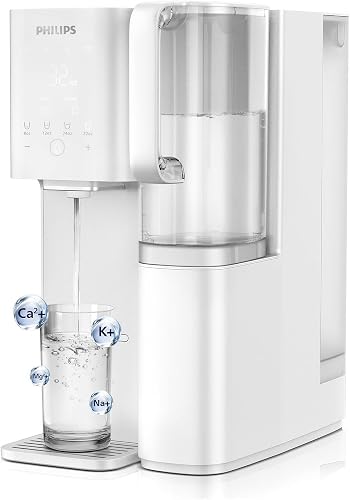
- 6 L tap water tank
- 1.8 L filtered water jug
- 6-stage filtration with mineralization
- Up to 12 month integrated filter
The 6 L source tank and 1.8 L jug suit a household that wants a larger reservoir. Philips recommends fresh tap water in the source tank each day.
Pros
- Large source tank
- Mineralization stage
- TDS in and out display
Cons
- Room-temperature water only
- Wide and tall dimensions need counter planning
The Philips Countertop RO 6L offers a 6 L tap water tank and 1.8 L filtered water jug. Philips describes a 6-stage RO process with mineralization and an integrated filter that lasts up to 12 months.
The system measures 9.1 x 16.5 x 12.8 in and dispenses about 200 ml per minute. It shows TDS in and out readings, and Philips recommends replacing the source tank water with fresh tap water each day.
Philips says the unit is designed for households of 2–5 people and dispenses room-temperature water only. It also recommends avoiding visibly cloudy or unclean source water.
Choose this model if a large source reservoir matters more than a compact body. Check the height and width against your counter before setting it up.
Bluevua ROPOT-Travel: Best for travel and tight counters

- 10 x 5 x 13.5 in dimensions
- Glass bottle included
- UV light
- Self-cleaning function
A narrow 5 in width and included glass bottle make this the smallest-footprint option in this group. It also has a self-cleaning function and filter life alert.
Pros
- Narrow footprint
- Glass bottle included
- Portable handle
Cons
- Small 18 oz dispensing amount
- No TDS or filter-life duration is specified
The Bluevua ROPOT-Travel measures 10 x 5 x 13.5 in and comes with a glass bottle. Its handle helps if you need a countertop unit that can be moved between spaces.
Bluevua describes 6-stage RO filtration with UV light, a self-cleaning function and filter life alert. The included bottle holds 18 oz for each dispensing cycle.
The small footprint suits a tight counter, office or travel setup with access to power. Bluevua describes a 3:1 filtered-to-waste ratio, but no filter life duration is stated.
Choose it when portability and counter width matter more than a larger ready-water reserve. Review the Bluevua vs DREO comparison if you are deciding between a compact unit and a larger pitcher setup.
How to choose a countertop reverse osmosis system
Choose by water volume, pitcher routine and clearance first, then compare filtration and maintenance details. A countertop unit still needs a stable surface, a nearby outlet and enough room to fill its tank.
How much capacity do you need?
A 3 L tank is a compact choice for one or two people, while 5 L or 6 L tanks reduce how often you may need to refill for a household. Consider the filtered pitcher size too, since a large source tank does not mean the serving container is equally large.
DREO offers 3 L and 5 L models, while Philips lists a 6 L source tank. Bluevua ROPOT-Travel focuses on an 18 oz dispensing amount and a narrow footprint.
Does a countertop RO system need plumbing?
These models sit on the counter, and several require no plumbing or permanent installation. They still need power, manual source-water refills and room to handle wastewater as directed.
If you rent or move often, check the unit's weight and dimensions as well as its setup. At 22.8 lb, AquaTru is heavier than the 5 kg Bluevua.
Should you choose mineral or carbon post-filtration?
A mineral post-filter adds minerals after RO, while a carbon post-filter is described as a taste stage. SimPure Y7T-A uses an alkaline mineral filter in its glass pitcher, and Y7T-C uses activated carbon.
Waterdrop C2SL has a mineral filter as well. Read our guide on what countertop RO removes, including minerals before choosing based on taste or mineral content.
How much counter clearance is needed?
Measure the height with lids open, not just the closed unit dimensions. SimPure Y7T-A and Y7T-C need at least 22 in of clearance for full lid opening, while other models have different shapes and pitcher access needs.
Measure depth and width too, then leave room to remove the tank or pitcher. If your kitchen is small, see our countertop filter options for apartments.
What filter claims should you compare?
Look for the exact standards and contaminants that matter to you. AquaTru says it is IAPMO certified to NSF/ANSI 41, 53, 58, 401 and P473, while other brands describe testing against NSF/ANSI 58.
A TDS meter can show dissolved solids readings before and after filtration, but those readings do not identify every contaminant. For a clearer view of the labels, read our NSF 42 vs 53 vs 58 guide.
What should you know about filter changes?
Filter life varies by model and can depend on water quality and usage. Waterdrop states up to 528 gallons or 12 months for C2SL, AquaTru describes a 600–1,200 gallon filter life range, and Philips describes an integrated filter lasting up to 12 months.
Check replacement filter availability and the unit's reminder system before choosing. You can also read our filter replacement guide for AquaTru and other RO systems.
Which countertop RO system should you choose?
Choose the DREO 3:1 Countertop RO if you want a 5 L capacity and two autofill pitchers, or the RO 112 if a 3 L unit fits your counter and routine better. Pick AquaTru Classic when its named certifications are your priority, and choose SimPure Y7T-A or Waterdrop C2SL if you want a mineral post-filter.
For a glass-pitcher shortlist, see our best countertop RO systems with a glass pitcher. If your main question is how RO changes mineral content, start with our countertop RO minerals guide.
Our top 3 picks at a glance
-
1
-
2
-
3
Frequently asked questions
What is the best countertop RO system for most kitchens?
The DREO 3:1 Countertop RO is the best fit for many kitchens that want a larger 5 L capacity and two autofill pitchers. For a smaller tank, the DREO RO 112 has 3 L capacity and one pitcher.
Measure your available counter depth and height before choosing either one.
Do countertop reverse osmosis systems need plumbing?
The models in this roundup are countertop units, and several explicitly require no plumbing or permanent installation. They still need counter space and a power outlet, and you need to refill their source tanks and manage the drained water according to the instructions.
Should I choose a countertop RO system with minerals added?
Choose a mineral post-filter if you prefer water with minerals added back after reverse osmosis. SimPure Y7T-A adds minerals through an alkaline pitcher filter, while Waterdrop C2SL has a mineral filter.
See our guide to countertop RO and mineral removal for what RO can change.
How do I choose between countertop RO systems?
Compare capacity, pitcher setup, counter clearance, filter replacement needs and the features you'll use each day. A 5 L unit with two pitchers suits a different routine than a compact travel model.
Our countertop water filter systems guide explains how RO compares with other countertop filter types.
What should I check before buying a countertop RO system?
Measure the space, including room above a lid that opens upward, and check that an outlet is nearby. Then review the filter replacement schedule and the system's water source requirements.
For a glass pitcher, see our guide to countertop RO systems with glass pitchers.


