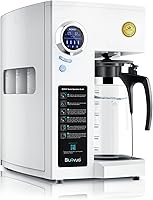
Is AquaTru Good for Well Water?
Yes, AquaTru is a good fit for most well water, because its certified reverse osmosis membrane removes 84 contaminants, including PFAS and microplastics. It only works well when your well water stays at or below 500 ppm TDS and you deal with sediment and hardness first.
On this page (7 sections)
- What does AquaTru actually remove from well water?
- How do you know if your well water suits AquaTru?
- How does AquaTru compare with other countertop options for well water?
- How much maintenance does AquaTru need on well water?
- What well-water problems does reverse osmosis not solve?
- How do you set up AquaTru for a well supply?
- So, is AquaTru good for well water?
Yes, AquaTru is a good fit for most well water, because its certified reverse osmosis membrane removes 84 contaminants, including PFAS and microplastics. It only works well when your well water stays at or below 500 ppm TDS and you deal with sediment and hardness first.
That last part matters more than the brand name. Well water varies from house to house, so the honest answer to "is AquaTru good for well water" starts with a test of your own supply.
What does AquaTru actually remove from well water?
AquaTru removes dissolved contaminants that ordinary filters miss, which is exactly what many private wells need. The maker says its Ultra Reverse Osmosis system is certified to NSF/ANSI standards 41, 53, 58, 401 and P473.
Those certifications cover 84 contaminants, including forever chemicals like PFOA and PFOS, plus microplastics. IAPMO tested the unit to those standards, which is a third-party check rather than a brand claim.
A reverse osmosis membrane works by forcing water through a layer so fine that dissolved salts and most molecules cannot pass.
That makes AquaTru a strong candidate for wells with nitrate, arsenic, lead or PFAS. A carbon-only pitcher filter, by contrast, mostly handles chlorine and taste.
The unit is also compact and needs no plumbing. It sits on the counter, plugs into a wall outlet, and fills its own 2.7 liter tank.
The housing is BPA-free plastic and the whole unit weighs 22.8 pounds, so one person can lift it into place. For a well-water household that rents or doesn't want to cut into pipes, that's a practical advantage.
How do you know if your well water suits AquaTru?
Start with a lab test, then compare the results to what reverse osmosis handles. A basic well-water panel gives you TDS, hardness, nitrate, bacteria and often arsenic and lead.
Three numbers decide most of the answer:
- TDS: AquaTru supports a maximum of 500 ppm. Above that, the membrane works harder and filter life drops.
- Hardness: high calcium and magnesium leave scale and shorten membrane life. Soften first if your well is very hard.
- Bacteria: RO removes many organisms, but a contaminated well needs disinfection or UV treatment as well.
If your report shows high sediment or iron, add a sediment prefilter or an iron treatment ahead of the RO unit. Those steps protect the membrane and keep the water tasting clean.
If your only issue is taste or light chlorine, a glass countertop water filter may be all you need. RO is the heavier tool for heavier problems.
How does AquaTru compare with other countertop options for well water?
AquaTru is the strongest general pick among the three for wells with dissolved contaminants, because it is the only one here built around a certified RO membrane. Its score of 8.6 reflects that fit.
The DREO RO 112 is the slimmer alternative. Its 0.0001 μm membrane reduces 99% of lead, chromium, chlorine, PFOS and PFOA and 97% of fluoride under lab conditions, and SGS tested it to NSF/ANSI 58.
Real-time TDS monitoring helps you watch a well's water quality as it changes with the seasons, and the self-cleaning cycle auto-flushes the internal tubes. It is also the lighter unit at 9.5 pounds, with a footprint of 14.51 by 6.73 inches and a 3 liter tank plus a 1.1 liter pitcher.
The Purewell gravity filter takes a different approach. Its 0.01 μm hollow fiber membrane and carbon block lower chlorine and trap rust, sediment and some heavy metals, and it needs no electricity.
It is certified to NSF/ANSI 42 and 372, and it holds 2.25 gallons at a flow rate of 4 gallons per hour. But its own instructions say the filter does not lower TDS.
So the split is clear. Pick RO when dissolved contaminants are the problem; pick gravity when you want simple, power-free filtering and your TDS is already fine.
Which one fits a well with high TDS?
AquaTru Classic fits wells up to 500 ppm TDS, and both RO units share that limit. The AquaTru Classic vs Carafe comparison breaks down how the two models differ in tank size and filter setup.
Above 500 ppm, neither countertop RO unit is the right first step. Treat the water or blend it before it reaches the unit.
Which one fits a cabin or off-grid well?
Purewell suits a cabin or off-grid setup, because gravity moves the water and no outlet is needed. Its 2.25 gallon capacity and 304 stainless housing hold up to outdoor use.
If you have power but want a backup method, the countertop water distiller roundup covers units that boil water into steam and leave contaminants behind.
How much maintenance does AquaTru need on well water?
Expect more frequent filter changes than a city-water household, because well water carries more sediment and dissolved solids. AquaTru says its filters last 600 to 1200 gallons, or about 6 months to 2 years.
On a clean municipal supply you might reach the top of that range. On a hard or dirty well, plan for the 6-month end.
The twist-and-change design makes the swap quick, and the first set comes with the unit.
A set of filters replaces about 4,500 plastic water bottles, according to the maker. That math assumes normal household use and a membrane that isn't clogged by heavy sediment.
Check the prefilter and sediment stage more often than the membrane. A cheap sediment cartridge ahead of the RO unit saves the expensive membrane, and it's the single best maintenance habit for well water.
The 22.8 pound unit and its 14 by 12 by 14 inch footprint need a stable counter spot near an outlet. Keep it out of direct sun and away from freezing windows in winter.
What well-water problems does reverse osmosis not solve?
RO does not fix bacteria, and it is not a whole-house treatment. If your well tests positive for coliform, deal with the source first: shock the well, fix the casing, and consider UV disinfection.
RO also wastes some water to the drain. That's fine for most homes, but a household on a weak or low-yield well should weigh the wastewater against the benefit.
It does not soften water in the whole-house sense. It removes minerals from the drinking water it treats, but your pipes and fixtures still see hard water.
A softener handles that side.
Finally, RO removes the minerals some people like in their water. If you prefer the taste of mineral-rich well water, a countertop water filter for well water that leaves minerals in place may suit you better than RO.
How do you set up AquaTru for a well supply?
Set up takes minutes and no plumbing, but well owners should add two steps before the first glass. Test the water, then decide whether a sediment prefilter belongs ahead of the unit.
- Pick a counter spot near an outlet and away from heat.
- Run a lab test on your well water and compare TDS to the 500 ppm limit.
- Add a sediment or iron prefilter if your report shows grit or metal.
- Install the included filters with a quarter twist and fill the tank.
- Run the first few tanks through and discard them, as the maker directs.
- Track gallons used so you change filters on time.
Discarding the first batches matters on any new RO unit. It flushes manufacturing residue from the membrane before you drink.
After that, refill from the tap as normal. The unit handles the rest, and you can top a glass straight from the dispenser.
So, is AquaTru good for well water?
For most private wells, yes. AquaTru Classic is a sound choice when your water tests under 500 ppm TDS and the concern is dissolved contamination like PFAS, nitrate or lead.
Its certified RO membrane removes 84 contaminants and the no-plumbing setup keeps installation simple.
The decision rule is short. Pick AquaTru Classic if your well report shows dissolved contaminants within the TDS limit and you want certified removal at the counter.
Pick the DREO RO 112 if you want the same RO method with live TDS monitoring in a slimmer, lighter body. Pick the Purewell gravity filter if your TDS is already fine and you want no-power filtering for sediment and chlorine.
Whatever you choose, test first. A low-cost lab panel tells you more about your well than any product page, and it's the step that makes the "is AquaTru good for well water" question answerable for your own tap.
Frequently asked questions
How often do AquaTru filters need changing on well water?
Plan on the shorter end of the maker's range. AquaTru says its filters last 600 to 1200 gallons, or 6 months to 2 years, and dirtier or harder well water pushes you toward 6 months.
A TDS reading and a quick look at the prefilter help you judge when to swap.
Can AquaTru handle hard well water?
It will run, but hard water shortens membrane life and can leave scale in the unit. If your well tests high for calcium and magnesium, soften the water first or accept more frequent filter changes.
Hardness also affects how the water tastes straight from the tap.
Do I need to test my well water before buying a countertop RO system?
Yes. A basic lab test tells you TDS, hardness, nitrate, bacteria and any local concerns like arsenic or lead.
That report decides whether reverse osmosis is the right method or whether you first need sediment and UV treatment.
Is a gravity filter better than AquaTru for well water?
Only in specific cases. A gravity filter like the Purewell needs no power and lowers chlorine and sediment, but it does not lower TDS.
If your well water carries dissolved salts, nitrate or PFAS, a reverse osmosis unit like AquaTru treats what gravity leaves behind.
How much water does AquaTru waste?
Countertop RO systems send some water to the drain to flush away the concentrated contaminants. AquaTru's maker markets it as a low-waste design compared with older under-sink systems.
The exact ratio depends on your water pressure and TDS.