What Does a Berkey Water Filter Filter?
A Berkey water filter with Black Berkey elements removes or dramatically reduces more than 200 typical contaminants that can be present in freshwater sources. It targets the broad mix of chemicals, heavy metals, and pathogens in tap water, though fluoride needs the separate PF-2 elements.
On this page (9 sections)
- What does a Berkey water filter actually remove?
- How do Black Berkey elements work?
- Which contaminants does it target?
- Does a Berkey filter remove fluoride?
- Does a Berkey filter bacteria and other pathogens?
- Which Berkey size fits your kitchen?
- How does a Berkey compare with other gravity filters?
- What a Berkey won't do
- So, what does a Berkey water filter filter?
A Berkey water filter with Black Berkey elements removes or dramatically reduces more than 200 typical contaminants that can be present in freshwater sources. It works on the broad mix found in treated tap water, and you add PF-2 elements if you also want fluoride and arsenic reduction.
So what does a Berkey water filter filter in practice? Berkey says its elements use a proprietary blend of several media types, tested by accredited third-party labs, and that blend targets far more than a plain carbon cartridge.
The rest of this guide breaks down what that means for your tap water.
What does a Berkey water filter actually remove?
The headline is broad-spectrum reduction, not one specific chemical. Berkey says authentic Black Berkey elements remove or dramatically reduce over 200 typical contaminants that could be present in freshwater sources.
That figure covers the categories that matter most in household water: chemicals that affect taste and odor, heavy metals, and the organisms that can make water risky to drink. Berkey positions the elements as the "Gold Standard" in gravity-fed filtration, and the multi-media build is the reason the list runs so long.
It's worth being clear about what a claim like this means. The 200+ figure is Berkey's own description of what its elements are designed to reduce, backed by testing at accredited labs.
It isn't a promise that your particular tap water will come out at zero for every item on that list.
Berkey also backs the elements against the lookalike filters that borrow its model numbers. The company says authentic BB9-2 elements are built to work with Berkey systems, while "compatible" black filters are typically made from activated carbon alone and target far less.
That's the main reason Berkey keeps repeating the word authentic.
How do Black Berkey elements work?
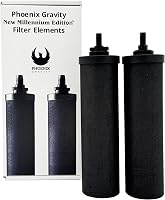
Water passes through a multi-stage filter bed, not a single sheet of carbon. Black Berkey elements (the original BB9-2) are made from a unique, proprietary blend of several media types, according to Berkey.
Each element is a hollow cylinder. Water flows from the upper chamber, through the element wall, and drips into the lower chamber, so every drop passes through the full media blend.
That's why Berkey says the elements work better than filters built only from activated carbon: the blend targets different contaminant types in sequence.
The design has no moving parts and no power supply. Gravity does the pushing, which is why a Berkey system needs no electricity, plumbing, or tools.
Priming the elements and fitting them in the upper chamber is the whole setup.
What's in the box when you set one up?
A Big Berkey ships with two authentic Black Berkey elements, a priming button, blocking plugs, washers, and assembly instructions. The Royal Berkey includes two Black Berkey elements and a standard spigot.
You prime the elements, install them in the upper chamber, fill with tap water, and let gravity do the rest. Berkey lists the flow rate as 0.03 gpm for the Big Berkey and 0.07 gpm for the Royal, so the bigger system drains roughly twice as fast when it's set up the same way.
Which contaminants does it target?
Think in three groups: taste-and-odor chemicals, metals, and microbes. Berkey says its Black elements reduce a broad range of commonly found contaminants that may be present in treated drinking water and affect quality, taste, and odor.
The first group covers the everyday offenders: chlorine and its byproducts, plus the organic compounds that give some tap water a chemical or earthy smell. The second group is heavy metals such as lead and the other metal ions that turn up in older plumbing.
The third is the biological side, where Berkey says the elements remove or dramatically reduce typical pathogens in freshwater sources.
Fluoride and arsenic are the big exceptions in the standard setup. Those two need the PF-2 elements, which is why Berkey sells them as an add-on rather than part of the base system.
Berkey also publishes a maximum supported TDS level for its systems, which is 1,000 ppm for the Big Berkey and 500 ppm for the Royal, so very mineral-heavy water is outside the intended range.
Does a Berkey filter remove fluoride?
No, the standard Black Berkey elements don't target fluoride. For that you add the Berkey PF-2 Fluoride and Arsenic Reduction Elements, which attach to the bottom of the Black elements and sit in the lower chamber.
The PF-2 elements use activated alumina to adsorb fluoride, arsenic(V), pre-oxidized arsenic(III), and other residual heavy metal ions. Berkey says they're designed to work in conjunction with authentic Black elements and should be replaced after 1,000 gallons under normal conditions.
They fit the Big Berkey, Royal Berkey, Crown Berkey, Imperial Berkey, Travel Berkey, and Berkey Light systems.
If your main reason for buying a gravity filter is fluoride, budget for a PF-2 set from the start. Without it, the system filters a lot, but not that.
Note that the PF-2 set carries its own shorter replacement interval of 1,000 gallons, so it wears out faster than the Black elements above it and needs its own schedule.
Does a Berkey filter bacteria and other pathogens?
Berkey says the Black elements remove or dramatically reduce typical pathogens in freshwater sources. That's a maker claim based on third-party lab testing, not a guarantee for every water source you might pour in.
Treat it as one layer of protection, not a licence to drink anything. For water you know or suspect is unsafe, follow local health guidance on boiling or approved treatment first.
A Berkey is a household water-improvement system for treated tap water, not a backcountry emergency purifier.
The upside is that gravity filtration leaves the water's minerals alone while it works on the contaminants. You get the reduction without the stripped, flat taste that some purification methods leave behind.
Which Berkey size fits your kitchen?
Pick by household size and daily demand, not by the biggest tank you can fit. The 2.25-gallon Big Berkey suits roughly 1–4 people; the 3.25-gallon Royal Berkey covers about 2–4 people with a bit more reserve.
Both use the same BB9-2 elements.
The Big Berkey is polished AISI 304 stainless steel and measures about 8.5 inches across and 19.25 inches tall when assembled. Its upper chamber nests inside the lower one for storage.
Berkey says each pair of elements handles up to 6,000 gallons, so the running cost per gallon stays low. Berkey notes the system is designed for approximately 1–4 people.
The Royal Berkey holds 3.25 gallons and can take up to four Black elements, so you can speed up refills for a bigger household. Berkey recommends replacing each pair after 6,000 gallons.
For more sizes, our guide to the best large capacity gravity water filter options compares the bigger tanks.
How does a Berkey compare with other gravity filters?
A Berkey covers more contaminant types than a basic ceramic gravity filter, at a higher upfront cost. Ceramic elements are excellent at trapping pathogens and sediment, but they lean on mechanical filtration rather than a multi-media chemical blend.
If your water is cloudy or you're mainly worried about bugs and grit, a ceramic gravity water filter does that job simply. If you want the broadest chemical and metal reduction from a countertop system, the Berkey's multi-media elements are the stronger fit.
Berkey has also changed its element lineup over time, and our Phoenix gravity water filter comparison explains what shifted.
Cost is the other difference. Before you commit, read how much a Berkey water filter costs to weigh the system against the 6,000-gallon element life.
What a Berkey won't do
It won't remove everything, and it won't tell you your water is safe. A Berkey doesn't target fluoride or arsenic without PF-2 elements, and it doesn't soften hard water.
It also doesn't replace a lab test when you need to know exactly what's in your supply.
Berkey's own figure is "over 200+ typical contaminants," which is a broad claim, not a complete one. If you have a specific concern such as lead from old pipes or nitrate from a well, test the water first and check that concern against the elements you plan to use.
The CDC's guide to choosing a water filter explains how to match a filter to a test result.
Finally, no gravity filter is instant. A Berkey filters at a slow drip, so fill it ahead of when you need the water and keep a spare pitcher in the fridge.
The flow rate tells you what to expect: a quarter-gallon every few minutes on the smaller system is normal, not a sign of a clogged element.
So, what does a Berkey water filter filter?
It filters the broad mix of chemicals, heavy metals, and pathogens in treated tap water, with fluoride and arsenic handled by the PF-2 add-on. If you want one countertop system for everyday drinking, cooking, and coffee, the Big Berkey 2.25 Gallon is the sensible start for most households.
The Royal Berkey 3.25 Gallon makes more sense for a larger household or when you want four elements for faster flow.
Add the Berkey PF-2 Fluoride Elements when fluoride is a concern for you. Check your water report or a home test first, match what you find to what the elements target, and the Berkey will earn its counter space.
Frequently asked questions
What does a Berkey water filter remove from tap water?
Black Berkey elements remove or dramatically reduce more than 200 typical contaminants that can be present in freshwater sources. Berkey says the elements are made from a proprietary blend of several media types, tested by accredited third-party labs, and they target a broad range rather than one pollutant.
Does a Berkey filter out bacteria and viruses?
Berkey says its Black elements remove or dramatically reduce the pathogens commonly found in freshwater sources. That's a maker claim backed by third-party lab testing, not a guarantee for every source.
For water you know is unsafe, follow local health advice on boiling or approved treatment first.
How long do Berkey filters last?
Berkey says each pair of Black Berkey elements handles up to 6,000 gallons before replacement is recommended. Adding another pair adds up to 6,000 gallons more.
Actual life varies with the quality of your incoming water, how much you use the system, and how well you maintain it.
Does a Berkey filter need electricity or plumbing?
No. A Berkey is a gravity-fed system: you fill the upper chamber with tap water, and gravity pulls it through the elements into the lower chamber.
There's no power, plumbing, or permanent installation, which is why the systems suit kitchens, apartments, offices, and RVs.