9 Best Ceramic Gravity Water Filters (October 2026)
The best ceramic gravity water filters include the ProOne Big+ Gravity Filter for family counters, the Alexapure Pro Gravity Filter for broad reduction claims, and the British Berkefeld 3.17 Gallon Ceramic for larger households.
On this page (3 sections)
The ProOne Big+ is a strong everyday ceramic gravity water filter choice for households that want a 3-gallon stainless steel dispenser. It needs no electricity, and ProOne rates its included filter for up to 9 months of regular daily use.
We compared capacity, materials, filter configuration, care intervals and stated reduction information. The right fit depends on how much water you need ready, where the unit will sit, and which contaminant claims matter to your household.
Our picks at a glance
-
1

-
2

-
3

- 4
 Check it
British Berkefeld 1.58 Gallon Ceramic
Best for tight counters - 5
 Check it
Culligan MaxClear Gravity Filter
Best for PFAS claims - 6
 Check it
ZenWater 6 Gallon Gravity Filter
Best for fewer refills - 7
 Check it
ZenWater 4 Gallon Gravity Filter
Best for mid-size storage - 8
 Check it
Purewell 4-Stage Ceramic Gravity Filter
Best for compatible systems - 9
 Best for solo travelCheck it
Which ceramic gravity water filter fits your household?
The ProOne Big+ suits regular countertop use, British Berkefeld offers several stainless steel formats with ceramic candles, and ZenWater prioritizes larger tank capacity. For a replacement filter instead of a complete system, consider the Purewell two-pack if it fits your current unit.
A gravity system works without an electrical connection or plumbing, but it still needs a stable surface and room for both chambers. Plan around the full height, the refill routine, and the time water takes to pass through the filter.
ProOne Big+ Gravity Filter: Best for family counters
- 3-gallon stainless steel system
- One 7 in filter included
- Filter rated for up to 9 months of regular daily use
- No electricity required
The 3-gallon stainless steel body suits regular countertop use, and the single filter keeps the setup simple. ProOne says the filter is rated for up to 9 months with regular daily use.
Pros
- Stainless steel body, spigot and stand
- No power needed
- One filter included
Cons
- One filter may be slower than a multi-filter setup
- Filter life depends on regular-use conditions
The ProOne Big+ pairs a 3-gallon stainless steel body with a stainless steel spigot and stand. Its one included 7-inch G2.0 filter makes this a straightforward choice for a household that wants a single element to install.
ProOne says the filter is rated for up to 9 months with regular daily use. The brand also says the G2.0 series carries NSF/ANSI 42 certification and has been tested by an independent lab to other NSF standards.
Check the exact test information for any contaminant you specifically need to reduce.
This is a good middle-size pick if a compact personal filter would mean constant refills and a 6-gallon tank would take too much room. Skip it if you need multiple filter elements for faster flow or want a smaller unit for one person.
Alexapure Pro Gravity Filter: Best for broad reduction claims
- Stainless steel system
- Activated carbon and carbon block
- Alexapure says it reduces 200+ common contaminants
- Countertop installation
Alexapure combines a stainless steel countertop system with activated carbon and carbon block filtration. The brand says it reduces more than 200 common contaminants.
Pros
- Stainless steel construction
- Carbon-based filtration
- Compact stated dimensions
Cons
- The data does not specify included filter count
- Confirm current setup and replacement details before choosing
The Alexapure Pro combines a stainless steel countertop system with activated carbon and carbon block filtration. Alexapure says it reduces more than 200 common contaminants, including lead, viruses, cysts, chlorine and fluoride.
At 14 x 9 x 9 inches, it has a compact stated footprint compared with the taller dispensers here. Its stated capacity is 5,000 gallons, but that figure is not a replacement schedule.
The included filter count is not specified, so confirm the configuration and replacement details before you buy.
Choose Alexapure if carbon-based filtration and its broad stated reduction claims match your priorities. Skip it if you specifically want a ceramic candle system, or if you need a clearly specified filter count before planning maintenance.
British Berkefeld 3.17 Gallon Ceramic: Best for larger households
- 3.17-gallon capacity
- Two Ultra Sterasyl ceramic candles
- Stainless steel construction
- Gravity-fed
This larger British Berkefeld system comes with two Ultra Sterasyl ceramic candles. Its 12-liter capacity gives it more storage than the smaller British Berkefeld models here.
Pros
- Two ceramic candles included
- Largest listed British Berkefeld size in this group
- No electricity or plumbing required
Cons
- Tall at 23.62 in
- Allow time for gravity filtration
This 3.17-gallon British Berkefeld includes two Ultra Sterasyl ceramic filter candles in a stainless steel gravity-fed dispenser. It needs no electricity or plumbing, making it suitable for a fixed countertop or a location where power is not dependable.
The 12-liter capacity gives it more storage than the smaller British Berkefeld countertop model in this group. Its 23.62-inch height calls for vertical clearance, so measure beneath cabinets and shelves before choosing it.
This is the clearest fit for a household that wants two ceramic candles and more stored water. Skip it if counter height is tight or a smaller reservoir better matches your daily use.
British Berkefeld describes the candles as reducing pathogens; confirm the specific test details for your water concerns.
British Berkefeld 1.58 Gallon Ceramic: Best for tight counters
- 1.58-gallon capacity
- Ceramic filtration
- Stainless steel dispenser
- No electricity required
The 6-liter British Berkefeld has a smaller stated capacity and dimensions than the larger ceramic system. Its stainless steel dispenser is intended for countertop placement.
Pros
- Smaller capacity for limited daily demand
- Compact stated dimensions
- Non-electric
Cons
- More frequent refills than larger tanks
- Filter life is listed as 6 months
The 1.58-gallon British Berkefeld is the smaller countertop option in this brand's two larger systems here. It has a stainless steel dispenser and ceramic filtration, with a 6-liter capacity and a 6-month filter cycle.
Its dimensions, 8.1 x 8.2 x 12.79 inches, make it easier to place than the taller 3.17-gallon model. The smaller reservoir also means more frequent refills, so it fits a modest household or a kitchen with limited vertical clearance.
Choose this model if a full-size countertop dispenser would crowd your space. Skip it if several people draw filtered water throughout the day and you want fewer refill rounds.
For care pointers across gravity systems, see our guide to cleaning and priming Berkey-style filters.
Culligan MaxClear Gravity Filter: Best for PFAS claims
- 2.25-gallon capacity
- Ceramic shell with granular activated carbon
- Culligan says it is NSF/ANSI 42 certified for stated reductions
- Up to 6 months per filter
Culligan combines a ceramic shell with granular activated carbon in a 2.25-gallon gravity system. Culligan says it is certified to NSF/ANSI 42 for reducing microplastics, lead and total PFAS.
Pros
- Ceramic and carbon media
- Stainless steel body
- No electricity or plumbing needed
Cons
- Capacity is below the 3-gallon options
- Filter life is up to 6 months per filter
Culligan MaxClear combines a ceramic shell with granular activated carbon in a 2.25-gallon stainless steel system. It includes one filter, runs on gravity, and requires no plumbing or electricity.
Culligan says the filter is certified to NSF/ANSI 42 for reducing microplastics, lead and total PFAS. Its stated service life is up to 6 months per filter, and Culligan says the Scout system can use up to two filters for faster and longer-lasting filtration.
This suits buyers who want ceramic and carbon media with specific stated reduction claims. The capacity is below the 3-gallon options, so skip it if fewer refills are your main goal.
Check the exact compatible replacement element before planning future filter changes.
ZenWater 6 Gallon Gravity Filter: Best for fewer refills
- 6-gallon capacity
- Plastic body
- Ceramic filter with additional filtration stages
- No electricity or plumbing required
ZenWater offers the largest stated capacity in this group, with a plastic body and a multi-stage system that includes a ceramic filter. Its footprint and height need more counter space.
Pros
- Largest stated tank capacity here
- No power or plumbing required
- Includes ceramic filtration
Cons
- Measures 13 x 13 x 24.25 in
- Claims about mineral and alkaline effects need careful review
ZenWater's 6-gallon system has the largest stated capacity in this roundup. Its plastic body uses gravity and its multi-stage design includes a ceramic filter.
The 13 x 13 x 24.25-inch footprint takes substantial counter or table space. A larger reservoir can reduce refill frequency, but it also adds water weight when full, so place it on a sturdy surface and make sure the height works for filling.
Choose this system if you want a large stored supply and have room for it. Skip it if you prefer stainless steel or want a compact dispenser.
ZenWater also describes alkaline and mineral effects; those claims are not a reason to expect a health benefit. Our guide to stainless steel gravity water filters covers systems built around that material.
ZenWater 4 Gallon Gravity Filter: Best for mid-size storage
- 4-gallon capacity
- Plastic body
- Ceramic filter and mineral stones
- No electricity required
The 4-gallon ZenWater provides less capacity than its 6-gallon sibling while retaining a ceramic filter and mineral stones. Its listed filter cycle is 1 year.
Pros
- More capacity than the British Berkefeld 1.58-gallon option
- Gravity powered
- Listed one-year filter cycle
Cons
- Plastic body
- Health-related mineral claims are not a reason to assume a health benefit
The 4-gallon ZenWater keeps the plastic construction and gravity operation of its larger sibling in a somewhat smaller format. Its system description includes a ceramic filter and mineral stones, and the stated filter cycle is 1 year.
At 12.5 x 12.5 x 22 inches, it still needs an open counter or table and a sturdy surface. Its 4-gallon capacity falls between the British Berkefeld 3.17-gallon option and the ZenWater 6-gallon model.
Pick it if you want more storage than a smaller countertop tank without choosing the largest option here. Skip it if a plastic body is not your preference or your available counter space is limited.
Read our ceramic and carbon filter comparison to understand how filter media choices differ.
Purewell 4-Stage Ceramic Gravity Filter: Best for compatible systems
- Four-stage ceramic hybrid filter
- Purewell says it is NSF/ANSI 53 certified
- Washable ceramic shell
- Two filters included
This pick is a two-pack of replacement filters, rather than a complete gravity system. Purewell says its four-stage filter is NSF/ANSI 53 certified and compatible with several gravity systems.
Pros
- Two filters included
- Washable ceramic shell
- Designed for compatible gravity systems
Cons
- Not a complete countertop system
- Confirm fit with your specific system
Purewell's four-stage ceramic filter is a two-pack of replacement elements, not a complete gravity dispenser. It combines ceramic, hybrid media, silver ion technology and activated carbon.
Purewell says the filter is NSF/ANSI 53 certified and that the washable ceramic shell helps maintain flow. The brand gives a capacity of up to 7,500 gallons per filter, and names several compatible gravity system brands.
This is a practical option if you already own a compatible system and want replacement elements with ceramic and carbon media. It is not a starter setup, and compatibility should be confirmed against your exact model before buying.
If you are still deciding whether gravity filtration fits your needs, read what gravity water filter labels mean.
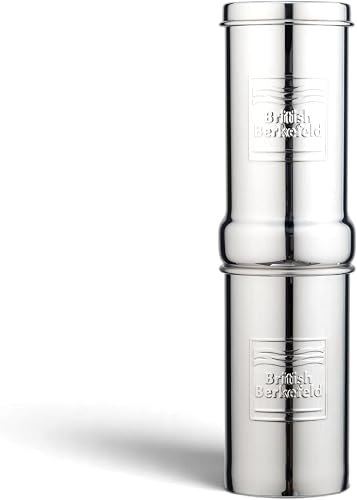
British Berkefeld 0.26 Gallon: Best for solo travel
- 0.26-gallon capacity
- Stainless steel body
- One Ultra Sterasyl filter included
- No power or plumbing required
This compact British Berkefeld system holds 1 liter and includes one Ultra Sterasyl filter. Its small capacity suits personal use or travel better than serving a household.
Pros
- Small, portable format
- Stainless steel construction
- Non-electric
Cons
- Only 1-liter capacity
- Filter change interval is 6 months
This 1-liter British Berkefeld is the most portable complete system in the roundup. It has a stainless steel body, includes one Ultra Sterasyl filter, and works without power or plumbing.
A liter suits personal use or travel better than a multi-person household. The stated filter life is 6 months, and its small reservoir means you will refill it often if you use filtered water throughout the day.
Choose it when portability and a small water supply matter most. Skip it for a shared kitchen or a household that wants a dispenser ready for several people.
What should you compare before buying a ceramic gravity filter?
Start with the specific contaminants you want to reduce, the supporting certification or test information, and your daily water demand. The word ceramic describes a filter material, but it does not identify every substance a particular element addresses.
Which filter claims should you check?
Look for a certification or test result tied to the exact filter model and the particular reduction claim. For example, Culligan identifies NSF/ANSI 42 certification for stated reductions, while Purewell identifies NSF/ANSI 53 certification.
Those standards and claims are not interchangeable, so read what each one covers.
Broad phrases such as “200+ contaminants” are not a useful substitute for checking a specific concern. If lead, PFAS, microbes or another substance drives your choice, confirm that the exact replacement element has relevant supporting information.
Our plain guide to gravity filter labels explains how to read those claims.
How much capacity does a gravity filter need?
Match capacity to the amount you drink between refills and the space available for the dispenser. A 1-liter unit is suited to one person or travel, while multi-gallon models are more practical when several people share the water.
Capacity is not the same as filtration speed. A large tank can hold more water, but gravity still takes time to move water through the elements.
Refill the upper chamber before the lower chamber is empty, and choose a size you can fill comfortably.
Is ceramic the same as ceramic and carbon filtration?
No. Some systems center on ceramic candles, while others combine ceramic with activated carbon or additional stages.
Media combinations can differ, so compare the exact filter claims instead of assuming that a longer stage list means broader performance.
Culligan MaxClear combines ceramic with granular activated carbon, and the Purewell replacement element also combines ceramic and carbon media. Compare their certifications and service instructions with a ceramic candle system such as British Berkefeld.
The ceramic versus carbon guide can help frame the choice.
What space and setup details matter?
Measure width, height and access before you choose a countertop system. Leave room to lift or remove the upper chamber for filling, and place the unit on a level, stable surface that can support the filled system.
Check what comes with the model before planning assembly. The systems vary in included elements and chamber sizes, while Purewell is only a replacement filter pack.
Keep the filter instructions nearby so the initial preparation and care match the exact element you own.
How do you maintain a ceramic gravity filter?
Follow the care schedule for your specific filter rather than applying one interval to every model. The British Berkefeld systems here specify 6 months, ProOne describes up to 9 months with regular daily use, Culligan states up to 6 months per filter, and the 4-gallon ZenWater gives a 1-year cycle.
ProOne recommends monthly cleaning and provides a specific first-use routine: scrub each filter under cold running water without letting water enter the blue stem, then run and discard 3 batches before drinking from the fourth. Its travel guidance says to dry the elements and wrap them for storage, and to avoid plastic bags or enclosed containers when storing unused filters for more than 4–7 days.
What common buying and use mistakes should you avoid?
The first mistake is choosing by tank size alone. A large dispenser takes more room, and it does not address whether its filter targets the contaminant you care about.
The second mistake is assuming all ceramic elements fit every gravity housing. Purewell names compatible brands, but you should confirm your exact model and connection before ordering a replacement.
The third mistake is ignoring routine care. Keep track of the replacement interval, clean the system as its manufacturer directs, and do not leave filtered water sitting indefinitely.
If flow slows, check the element and follow the maker's cleaning instructions before assuming the whole unit needs replacement. Our guide to slow gravity filters covers common flow causes.
Which ceramic gravity water filter should you choose?
Choose the ProOne Big+ for a balanced 3-gallon stainless steel countertop system, the 3.17-gallon British Berkefeld for two ceramic candles and more reservoir space, or the 1-liter British Berkefeld for portable personal use. Pick ZenWater's 6-gallon model when storage volume is your top priority and you have room for its larger plastic body.
Choose Culligan if its ceramic and carbon design and stated NSF/ANSI 42 claims match your needs, and choose Purewell only if you need compatible replacement filters. Before buying any ceramic gravity water filter, confirm the exact reduction claims, available space and replacement routine.
If refill frequency matters most, compare more options in our large-capacity gravity filter guide.
Our top 3 picks at a glance
-
1
-
2
-
3
Frequently asked questions
What is a ceramic gravity water filter?
A ceramic gravity water filter uses gravity to move water from an upper chamber through a ceramic element into a lower chamber. Some systems combine ceramic with activated carbon or other media.
The exact contaminant reductions depend on the filter model.
Check the model's certification or test information for the substances you want to address.
Are ceramic gravity water filters good for countertop use?
Yes, many ceramic gravity filters are built for countertop use without plumbing or electricity. Choose a capacity that matches daily use, then measure the filled unit's space and leave room to remove the upper chamber for refilling.
Gravity filtration takes time, so refill before the lower chamber runs dry.
How often do ceramic gravity filters need replacement?
Replacement intervals vary by filter and use. The British Berkefeld systems here specify 6 months, while ProOne describes up to 9 months with regular daily use.
Follow the care instructions for your exact filter, and replace it sooner if the manufacturer directs you to do so.
Do ceramic filters remove every contaminant?
No. A ceramic element should not be assumed to address every contaminant, and systems that look similar can use different media and have different certifications.
Check independent certification or test information for the exact filter and the specific substances it covers.
Use current local water quality information to guide your choice.
How do I choose the right ceramic gravity filter size?
Choose based on how much filtered water you use between refills and how much counter space you can spare. These options range from a 1-liter personal system to a 6-gallon dispenser.
Measure both width and height, and leave enough room to lift the upper chamber or pour water into it.


