7 Best Countertop Gravity Water Filter Systems (November 2026)
The best countertop gravity water filter systems include the Purewell 3-Stage Gravity Fed Water Filter System (best overall), the Big Berkey 2.25 Gal Gravity Water Filter for larger households, and the Waterdrop TK Gravity Water Filter System for outdoor use.
On this page (8 sections)
- The best countertop gravity water filter systems for different kitchens
- How the 7 gravity systems compare
- How these countertop gravity filters were compared
- What should you check before buying a gravity water filter?
- Which gravity filter material suits your water?
- How much does a gravity filter cost to run?
- Do you need NSF or IAPMO certification?
- Verdict: which gravity filter should you buy?
The best countertop gravity water filter system for most kitchens is the Purewell 3-Stage, because two washable ceramic filters are rated for 10,000 gallons together and the stand and spigot come in the box. Pick the Big Berkey if you want to add filter elements for faster flow, or the British Berkefeld if bacteria and cysts are your main concern.
Gravity systems earn their counter space by skipping electricity and plumbing. You pour tap water into the top chamber, wait, and draw filtered water from a spigot at the base.
That makes them useful in apartments, RVs, off-grid cabins and kitchens where a plumbed-in filter is not an option.
Our picks at a glance
-
1

-
2
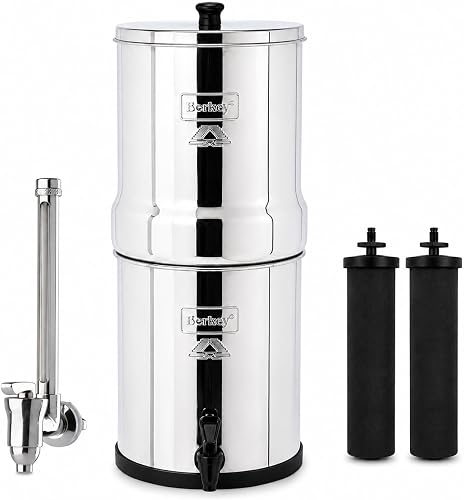 Best for larger households
Big Berkey 2.25 Gal Gravity Water Filter
9.0/10 our score
See it on Amazon -
3

- 4
 Best for lead and PFAS reductionCheck it
- 5
 Check it
British Berkefeld 3.17 Gallon Ceramic
Best for bacteria and cysts - 6
 Check it
IceJoy Ultra-Filtration Gravity Water Filter System
Best for fine particle removal - 7
 Check it
ZenWater 4 Gallon Gravity Filter
Best for alkaline water
The best countertop gravity water filter systems for different kitchens
Purewell leads on filter life and included accessories, while the other picks earn their place on capacity, certification or pore size. Choose by the job you need done, then check the footprint against your counter.
Purewell 3-Stage Gravity Fed Water Filter System: Best overall
- 2.25-gallon capacity
- Two washable ceramic filters
- 304 stainless steel body
- Rated for 10,000 gallons total
Two ceramic filters rated for 5,000 gallons each make this the longest-lasting set here. The stand and spigot come in the box.
Pros
- Two filters rated for 10,000 gallons total
- Washable ceramic outer layer
- Stand and spigot included
Cons
- Does not lower TDS
- Top chamber overflows if you refill a full bottom tank
Purewell suits a kitchen that wants one purchase to cover everything. The set includes the upper and lower chambers, a 304 stainless steel spigot and a non-slip stand, so there is nothing extra to buy before the first pour.
Its ceramic filters use a three-layer design: an outer ceramic shell blocks large particles, activated carbon in the middle targets chlorine, and silver ions inside work against growth between uses. Purewell says the pair handles up to 10,000 gallons, or 5,000 per element.
The ceramic surface is washable. When sediment builds up, scrub it with the included sponge to stretch the filter's life.
Skip soap, since it can clog the pores. Purewell also advises flushing each filter for a minute under a faucet before the first use.
It holds 2.25 gallons and stands 20 inches tall on an 8.8-inch base, and the whole unit weighs 7.7 pounds. Purewell notes that it does not lower TDS, so dissolved minerals stay in the water.
The main habit to learn is not refilling the top chamber while the bottom tank is full, or water leaks out.
Buy it for a first gravity filter that arrives ready to use. For more on how these units compare with plumbed options, see our countertop water filter system guide.
Big Berkey 2.25 Gal Gravity Water Filter: Best for larger households
- 2.25-gallon capacity
- Two Black Berkey elements
- 7-inch water view spigot
- Rated for 6,000 gallons per filter pair
The polished stainless steel body and water view spigot suit a family kitchen. The system takes up to four elements for faster flow.
Pros
- Accepts up to four filter elements
- Water view spigot shows the water level
- PF-2 fluoride and arsenic filters included
Cons
- Lowest stated TDS ceiling in this group
- Upper chamber nests inside the lower only when disassembled
Berkey suits a family of about 1 to 4 people who want a long-established name in gravity filtration. The 2.25-gallon stainless body carries two authentic Black Berkey elements and a 7-inch water view spigot, so you can see the level in the bottom tank without lifting the lid.
What sets it apart is expansion. The upper chamber takes up to four Black Berkey elements (sold separately), which raises the flow rate when the household grows or guests arrive.
Berkey says each pair of elements covers up to 6,000 gallons.
The kit also includes two PF-2 fluoride and arsenic reduction filters that fit below the main elements. Berkey rates each pair at 1,000 gallons.
The box also holds a priming button, blocking plugs and washers.
The polished AISI 304 stainless body measures about 8.5 inches across and 19.25 inches tall. When you break it down, the upper chamber nests inside the lower one for storage.
Berkey lists a 300 ppm TDS ceiling for the system. If your tap water runs harder than that, check the reading before you commit.
Berkey also states the elements were tested by third-party labs against more than 200 contaminants.
Buy it for a growing household that may want more flow later. Pair it with a stainless steel gravity water filter if looks matter in an open kitchen.
Waterdrop TK Gravity Water Filter System: Best for outdoor use
- 2.25-gallon capacity
- Two coconut carbon filters
- Metal water-level spigot
- Rated for 6,000 gallons
The short 15.74-inch body fits under more cabinet gaps than the taller picks. Two filters cover 6,000 gallons and need no electricity.
Pros
- Shortest cabinet height here
- Two filters rated for 6,000 gallons
- Sight spigot shows remaining water
Cons
- Does not lower TDS
- Faucet fit can splash if the tap is not compatible
Waterdrop suits small kitchens and travel. At 15.74 inches tall it is the shortest unit in this roundup, so it clears more cabinet gaps and fits more easily on a crowded counter or in an RV.
The King Tank holds 2.25 gallons and carries two coconut activated carbon filters rated for 6,000 gallons. Waterdrop says that saves up to 45,000 plastic bottles over three years.
The set includes the system, the two replacement filters and a user manual.
Its metal water-level spigot shows how much filtered water is left and is built to avoid leaks. The body is 304 food-grade stainless steel.
Waterdrop holds NSF/ANSI 372 certification for the system and NSF/ANSI 42 for the carbon filter's chlorine, taste and odor reduction. The brand also covers the system with a one-year warranty.
Waterdrop says the filters cut chlorine by up to 98% in third-party lab tests. It also states the system does not lower TDS.
One practical note from Waterdrop: if your faucet is not fully compatible with the top chamber, splashing can happen when you refill. The system has two filter holes and accepts two carbon filters plus two fluoride filters.
Setup needs no plumbing experience.
Buy it for an RV, a camper or a low-clearance counter. Waterdrop is an independent brand and states it is not affiliated with Berkey.
ProOne Big+ Gravity Filter: Best for lead and PFAS reduction
- 3-gallon capacity
- IAPMO certified for lead and total PFAS
- Stainless steel spigot and stand
- G2.0 filters last up to 9 months
A 3-gallon stainless body with one G2.0 filter that the maker says lasts up to 9 months. It is certified for lead and total PFAS reduction.
Pros
- IAPMO certified for lead and total PFAS
- 3-gallon stainless steel body
- G2.0 filter lasts up to 9 months
Cons
- One filter in the base kit
- Monthly cleaning recommended
ProOne suits buyers who care most about what a filter removes from tap water. The Big+ is IAPMO certified to reduce lead and total PFAS, along with microplastics and chlorine taste and odor.
That is a specific set of claims the other picks here do not carry in the same way.
The body is a 3-gallon polished stainless steel tank with a stainless spigot and stand. A mat is included too.
The base kit includes one G2.0 filter, which ProOne says lasts up to 9 months with daily use. The filters are infused with silver to help prevent unwanted growth, and the G2.0 series carries NSF/ANSI 42 certification as well.
ProOne recommends cleaning the system and filters at least once a month. That is more upkeep than scrubbing a ceramic element when it looks dirty.
For first use, ProOne advises scrubbing each filter without letting water into the blue stem, then cycling three batches of water and dumping them before drinking from the fourth.
It also works as an emergency unit: no electricity means it keeps running when the power is out. For storage longer than 4 to 7 days, ProOne says to drain the water and air-dry the filters.
Buy it for lead or PFAS worries in treated city water. If you only need chlorine and taste handled, the simpler Purewell or Waterdrop picks need less upkeep.
British Berkefeld 3.17 Gallon Ceramic: Best for bacteria and cysts
- 12-liter (3.17-gallon) capacity
- Two Ultra Sterasyl ceramic candles
- Removes up to 99.99% of bacteria and cysts
- 6-month filter life
Ceramic candle filters from a British brand with almost 200 years in water treatment. It is the pick for households worried about bacteria and cysts.
Pros
- Two ceramic candles rated for 99.99% bacteria removal
- Large 12-liter body
- 6-month filter life
Cons
- Tallest unit in this group
- Filter candles take hours to process a full tank
British Berkefeld suits households whose tap water source is uncertain. The 12-liter (3.17-gallon) stainless body carries two Ultra Sterasyl ceramic candles, and the brand says they remove up to 99.99% of harmful bacteria, cysts and other waterborne pathogens.
The Doulton name has almost 200 years behind it, and the candles are made in the UK's Potteries district. Berkefeld lists a 6-month filter life for the candles.
Because they are ceramic, a surface scrub keeps them working without replacement. The set arrives as one can plus two filters.
The tank is the tallest pick here at 23.62 inches, and its base is 11.81 inches square. That size gives you more stored water but asks for more vertical clearance.
A full 12 liters also takes hours to pass through two candles, so plan refills ahead.
It works in a kitchen, on a camping trip or in an RV. Berkefeld lists a 600 ppm TDS ceiling.
The ceramic build is the reason to choose it, not speed. Its gravity-fed design needs no electricity or plumbing.
Buy it for a large household or an off-grid setup. For smaller ceramic units, our ceramic gravity water filter roundup has more options.
IceJoy Ultra-Filtration Gravity Water Filter System: Best for fine particle removal
- 2.25-gallon capacity
- 0.01-micron UF membrane
- Sight glass spigot
- 6,000 gallons per filter set
The 0.01-micron membrane is the finest pore size in this roundup. Two carbon block filters cover 6,000 gallons.
Pros
- 0.01-micron membrane filtration
- Sight glass spigot for water level
- Rated for 6,000 gallons per set
Cons
- Does not lower TDS
- Top chamber can overflow if the bottom tank is full
IceJoy suits readers who want the finest pore size on the counter. Its composite filter combines a 0.01-micron hollow fiber UF membrane, a silver-ion layer and an activated carbon block.
IceJoy says that membrane is about 7,000 times thinner than a human hair and 20 times more precise than a standard 0.2-micron filter.
That precision is aimed at particles and pathogens rather than dissolved solids. The brand says the system filters out chlorine, PFAS, bad taste, odors, fluoride, heavy metals, microplastics and bacteria, while leaving TDS in place.
Two carbon block filters cover 6,000 gallons, or 3,000 each, and IceJoy says they typically last up to 6 months depending on water quality. The stainless steel body is lead-free 304 grade.
A sight glass spigot lets you read the bottom tank without opening the lid.
It holds 2.25 gallons on an 8.9-inch base and stands 20 inches tall. As with the Purewell, do not add water to the top chamber when the bottom tank is full.
IceJoy lists a 300 ppm TDS ceiling. Replacement cartridges are sold under separate part numbers when the pair runs out.
Buy it for the smallest pore rating in this roundup. If you want a pure ceramic outer layer, the British Berkefeld is the closer match.
ZenWater 4 Gallon Gravity Filter: Best for alkaline water
- 4-gallon capacity
- 8-stage purification
- Mineral stones and alkaline media
- Rated for 500 gallons
The largest tank in this group, with mineral stones that add calcium and other minerals back to the water. Its filter set covers 500 gallons.
Pros
- Largest 4-gallon tank here
- Alkaline and mineral media in the stack
- No electricity or plumbing needed
Cons
- Shortest filter life in this group
- Plastic body rather than stainless steel
ZenWater suits buyers who want alkaline water without bottled jugs. Its 4-gallon tank is the largest here, and its 8-stage stack combines a ceramic filter, activated carbon, silica sand, far-infrared ceramic balls, Maifan mineral stones and a magnetic component.
The idea is to filter and then mineralize. ZenWater says the mineral stones add calcium, zinc, potassium and manganese and raise the alkalinity of the water.
The ceramic layer traps sediment and the carbon takes out bad taste and odor. No electricity or plumbing is needed.
The trade-off is filter life. ZenWater rates the set for about 500 gallons and roughly a year of use, far less than the 6,000 to 10,000 gallons the stainless picks claim.
You will replace filters sooner and spend more over time.
The body is plastic rather than stainless steel and measures 12.5 inches across and 22 inches tall. It weighs 6.5 pounds.
It suits a buyer who wants an alkaline result and does not mind the shorter filter interval.
Buy it for alkaline and mineral water on a budget. If long filter life matters more, skip it for the Purewell or Big Berkey.
How the 7 gravity systems compare
The table puts the core specs side by side so you can match tank size, filter life and build to your kitchen. Scores reflect how well each unit fits what most gravity-filter shoppers need.
| Product | Best for | Capacity | Size (L x W x H) | Power source | Our score |
|---|---|---|---|---|---|
| Purewell 3-Stage Gravity Fed Water Filter System | overall | 2.25 gallons | 8.8 x 8.8 x 20 in | Non electric | 9.6 |
| Big Berkey 2.25 Gal Gravity Water Filter | larger households | 2.25 gallons | 19.25 x 8.5 x 19.25 in | Non electric | 9.0 |
| Waterdrop TK Gravity Water Filter System | outdoor use | 2.25 gallons | 9.44 x 9.44 x 15.74 in | Gravity-fed | 8.6 |
| ProOne Big+ Gravity Filter | lead and PFAS reduction | 3 gallons | Non electric | 8.4 | |
| British Berkefeld 3.17 Gallon Ceramic | bacteria and cysts | 12 liters | 11.81 x 11.81 x 23.62 in | Gravity fed | 8.2 |
| IceJoy Ultra-Filtration Gravity Water Filter System | fine particle removal | 2.25 gallons | 8.9 x 8.9 x 20 in | Gravity | 8.1 |
| ZenWater 4 Gallon Gravity Filter | alkaline water | 4 gallons | 12.5 x 12.5 x 22 in | Gravity | 7.5 |
Our score weighs specs, features and buyer feedback against what you're shopping for. We ranked filter life and certification highest, then capacity and footprint, then extras like spigot style.
The Purewell tops the list because it delivers long filter life and a complete accessory set at a moderate footprint.
How these countertop gravity filters were compared
We checked the published specs for each unit and lined up the numbers that change daily use: tank size, footprint, filter type and rated filter life. Certification came next, since it separates a general taste fix from a targeted contaminant claim.
We also weighed what arrives in the box. A system that includes a stand, spigot and both filters saves a second purchase.
Then we looked at power: all seven run on gravity alone, so none needs an outlet.
Filter life carried a lot of weight because it drives long-term cost. A 500-gallon set and a 10,000-gallon set both filter water, but the second one asks far less of your time and money.
We also noted each maker's stated TDS ceiling, since hard water can shorten how long a filter lasts.
What should you check before buying a gravity water filter?
Start with your water. A gravity filter with a carbon stage handles chlorine, taste and odor well.
If your tap tests high for lead or PFAS, look for a unit with a certification naming that contaminant, like the ProOne.
If bacteria or cysts are the worry, a ceramic candle system like the British Berkefeld is the safer fit. Match the filter to the problem you actually have, not to the longest feature list.
Check your counter footprint and height
Measure the spot before you order. The 2.25-gallon stainless models here run about 9 inches across and 15 to 20 inches tall.
The British Berkefeld stands 23.62 inches tall on an 11.81-inch base. You also need room above the lid to pour.
Decide how much water you use in a day
A 2.25-gallon tank covers a couple or a small family between refills. A 3-gallon ProOne or 4-gallon ZenWater means fewer trips to the sink.
Larger tanks also weigh more when full, so lifting them to clean gets harder.
Match the filter to your water supply
City water usually needs chlorine, taste and odor handled, which any carbon stage does. Well water or an uncertain source calls for the pathogen protection of ceramic candles.
If you move between a kitchen and an RV, pick a short unit that packs down.
Which gravity filter material suits your water?
Stainless steel wins for most kitchens. It resists corrosion, cleans up easily and does not affect taste.
All the 2.25-gallon and larger picks except ZenWater use 304 stainless steel bodies. The Purewell, Berkey, Waterdrop, ProOne and British Berkefeld all fall in this group.
Ceramic candles versus carbon block elements
Ceramic candles trap particles and pathogens in their outer layer and can be scrubbed back to life. Carbon block filters target chlorine, taste and odor and some heavy metals.
Several systems here combine both, so you rarely have to choose one alone. Purewell stacks ceramic over carbon and silver, while IceJoy pairs a carbon block with a hollow fiber membrane.
Plastic tanks for alkaline water
ZenWater's plastic body is lighter and costs less than steel. It also houses mineral stones that the metal units do not include.
If you want added minerals, the plastic tank is the practical route. If you want durability and a metal spigot, stay with steel.
How much does a gravity filter cost to run?
The running cost comes down to gallons per filter set. The Purewell's pair is rated for 10,000 gallons.
Berkey, Waterdrop and IceJoy rate their pairs at 6,000 gallons. British Berkefeld's candles last about 6 months.
ProOne's single G2.0 filter lasts up to 9 months. ZenWater's set covers 500 gallons.
Divide the gallons by your daily use to see how often you will buy replacements. A household drinking 2 gallons a day runs through ZenWater's 500-gallon set in about 8 months.
The same household would go more than 2 years on Purewell's set.
Washable ceramic elements stretch the interval further. Scrubbing the surface when sediment appears keeps water flowing and delays replacement.
Do you need NSF or IAPMO certification?
Yes, if a health claim matters to you. Certification confirms a third-party lab tested the filter against a published standard.
Waterdrop's system holds NSF/ANSI 372 and its carbon filter holds NSF/ANSI 42. Purewell's ceramic filter is certified to NSF/ANSI 372 for lead-free materials.
ProOne's Big+ is IAPMO certified for lead and total PFAS.
What NSF/ANSI 42 and 372 cover
NSF/ANSI 42 covers chlorine, taste and odor reduction. NSF/ANSI 372 covers lead-free materials in the wetted parts.
Neither standard confirms bacteria removal, so if pathogens are your concern, look for a ceramic candle with a stated removal rate.
Reading the 99% claims
Purewell says its carbon layer removes 99% of chlorine. British Berkefeld says its candles remove up to 99.99% of bacteria and cysts.
These are different jobs: chlorine affects taste and odor, while bacteria and cysts affect safety. Check which one a claim is about before you compare numbers.
A carbon figure also applies to the media, not to every drop that leaves the spigot.
Verdict: which gravity filter should you buy?
The best countertop gravity water filter system for most kitchens is the Purewell 3-Stage, with the longest filter life in this roundup and a stand and spigot in the box. Its washable ceramic elements keep maintenance simple and its 2.25-gallon tank suits a couple or small family.
Choose the Big Berkey if you want room to add filter elements and a fluoride stage. Pick the Waterdrop TK for an RV or a low cabinet.
Go with the ProOne for lead and PFAS certification, or the British Berkefeld for bacteria and cysts. IceJoy is the pick for the finest membrane, and ZenWater for alkaline water on a budget.
Whichever you choose, fill it the night before and let gravity do the rest. For larger tanks and bigger households, our large capacity gravity water filter guide covers the next size up.
Our top 3 picks at a glance
-
1
-
2
Best for larger households
Big Berkey 2.25 Gal Gravity Water Filter
9.0/10 our score
See it on Amazon -
3
Frequently asked questions
Do gravity water filters remove minerals or lower TDS?
Most gravity filters leave dissolved minerals in the water. The Purewell, Waterdrop and IceJoy units do not lower TDS.
ZenWater adds minerals back through its mineral stones.
If you want water stripped of dissolved solids, a distiller or reverse osmosis system is the right tool.
How often do I need to replace the filters?
It depends on the model and your water quality. Purewell rates its ceramic elements at 5,000 gallons each.
Berkey, Waterdrop and IceJoy rate their filter pairs at 6,000 gallons.
ProOne's G2.0 filter lasts up to 9 months, and ZenWater's set covers 500 gallons.
Can I use a gravity water filter during a power outage?
Yes. Every pick in this roundup runs without electricity, so a full tank keeps dispensing water when the grid is down.
Fill the top chamber before a storm so the bottom tank is ready when you need it.
What is the difference between ceramic and carbon gravity filters?
Ceramic elements trap sediment and pathogens in their outer pores and can be scrubbed clean. Carbon filters target chlorine, taste and odor, and some heavy metals.
Many systems, including the Purewell, pair a ceramic outer layer with carbon and silver inside.
How much counter space does a gravity filter need?
The 2.25-gallon stainless models here measure about 9 inches across and 15 to 20 inches tall. The 3-gallon and 12-liter units run 11 to 12 inches across.
Leave headroom above the lid so you can lift it and pour in water.


