9 Best Home Water Distiller Machines (November 2026)
The best home water distiller machines include the VEVOR Water Distiller for large daily batches, the VEVOR Water Distiller for glass container fans, and the CO-Z 6L Water Distiller for cleaning supplies included.
On this page (7 sections)
- The best home water distiller machines, ranked
- How these home distiller machines compare
- Which size distiller do you need for daily drinking water?
- Glass or plastic container: which is better on a distiller?
- How much does it cost to run a countertop distiller?
- What to check before you buy a home water distiller machine
- Verdict: the best home water distiller machine for most homes
The best home water distiller machine for most households is the VEVOR 6L/1.6 Gallon, because its 900W heater and large tank make up to 31.2L of distilled water a day without constant refilling. Pick the VEVOR glass version if you want a glass pitcher, or the CO-Z 6L if you'd rather have cleaning supplies in the box.
A distiller is the simplest way to get near-zero TDS water at home: it boils water, leaves the minerals and contaminants behind, and condenses the steam into a clean pitcher. The trade-off is time.
Most units here make about 1L an hour, so the tank size and the wattage decide how much water you actually get each day.
This guide compares nine countertop machines by tank size, heater wattage, container material and what comes in the box. For the broader category, our roundup of the best countertop water distillers covers the same ground from a different angle.
If you're still weighing distillation against other methods, the best water distillers for home use page puts the options side by side.
Our picks at a glance
-
1

-
2
-
3

- 4
 Check it
ROVSUN Upgraded 1.1 Gallon/4L Water Distiller Countertop
Best for overnight running - 5
 Check it
DC HOUSE 1 Gallon Water Distiller Machine
Best for humidifiers and CPAP - 6
 Check it
ROVSUN【Upgraded】 1.1 Gallon/4L Water Distiller Stainless Steel
Best for zero plastic contact - 7
 Check it
CO-Z 1.1 Gallon Water Distiller
Best for small kitchens - 8
 Check it
ROVSUN 1.1 Gallon Water Distiller for CPAP
Best for travel and small rooms - 9
 Best budget first distillerCheck it
The best home water distiller machines, ranked
The top pick is the VEVOR 6L for its large tank and fast 900W heater. Every other machine here wins on a specific need: glass instead of plastic, included cleaning supplies, a smaller footprint or a lower entry point.
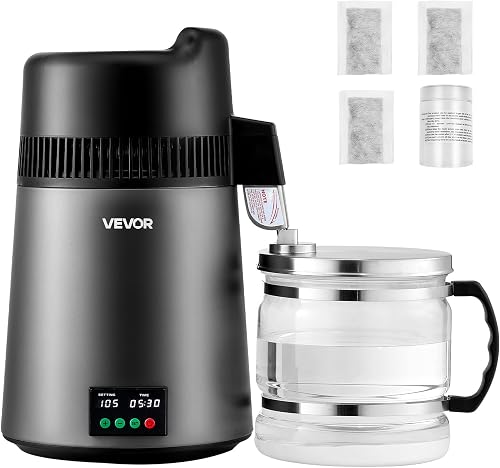
VEVOR Water Distiller: Best for large daily batches
- 900W, 1.3L per hour
- 6L/1.6 gallon tank
- 304 stainless interior
- PBT plastic container
A 900W heater and a 1.6 gallon tank turn out about 1.3L an hour and up to 31.2L a day. The food-grade plastic pitcher stays light enough to carry.
Pros
- Large 6L tank
- Aluminum four-blade cooling fan
- Replacement carbon packs included
Cons
- Heaviest of the 1.6 gallon picks
This is the machine to buy if you want one pitcher of distilled water a day and no more. The 900W heater moves over 1.3L an hour, so a full 6L tank takes roughly 4.5 hours and the daily ceiling is 31.2L.
The 304 stainless interior covers everything that touches water, and the PBT plastic pitcher stays light when full. VEVOR upgraded the top fan to an aluminum four-blade unit and the exhaust cover to 304 stainless, which should help heat dissipation over long runs.
The unit measures 11.81 by 11.81 in and stands 19.69 in tall, so it needs a square of counter with headroom above it.
You get replacement activated carbon packs in the box, and VEVOR notes that citric acid strips scale. Plan on a cleaning routine every couple of weeks if your tap water is hard.
The main cost against the glass model below is the plastic container, and the 10.8 lb body is heavy to move once it's full. For a big family or daily coffee and cooking water, the capacity is the reason to choose it.
VEVOR Water Distiller: Best for glass container fans
- 900W, 1.3L per hour
- 6L/1.6 gallon tank
- High borosilicate glass pitcher
- 304 stainless interior
Same 900W engine and stainless tank as the top pick, but the collector is high borosilicate glass. That keeps water off plastic at the collection stage.
Pros
- Glass collection pitcher
- Aluminum cooling fan
- Upgraded 304 stainless exhaust cover
Cons
- Glass pitcher is heavier to carry
If you want distilled water that never sits in plastic, this is the version to get. It shares the 900W heater, the 304 stainless tank and the 1.3L-per-hour rate with the top pick, but the collector is high borosilicate glass.
That change matters if you brew coffee, mix formula or store water in the pitcher for a day or two. The glass pitcher is heavier than the plastic one, and at 14.6 lb the whole unit is about 4 lb heavier than the plastic version.
Carrying a full glass pitcher from counter to fridge needs a steady hand.
Everything else holds: aluminum cooling fan, upgraded stainless exhaust cover, carbon packs and citric acid advice. The daily output is the same 31.2L, and the footprint matches the plastic model at 11.81 by 11.81 in.
Pick it over the plastic model when glass is worth the extra weight to you, and skip it if the pitcher will move around a lot. Our VEVOR water distiller review digs into the brand's models in more detail.
CO-Z 6L Water Distiller: Best for cleaning supplies included
- 900W, 0.34 gallons per hour
- 1.6 gallon pot
- Stainless steel and plastic parts
- Chamber cleaner, carbon packs and citric acid included
CO-Z bundles a chamber cleaner, three carbon packs and citric acid with its 1.6 gallon pot. The one-button cycle and large opening keep refills and cleanup simple.
Pros
- Cleaning powder and citric acid in the box
- Large 1.6 gallon pot
- Single-button start and stop
Cons
- No glass container option
CO-Z bundles the upkeep into the purchase. You get a chamber cleaner, three carbon packs and a bottle of citric acid with the 1.6 gallon pot, which is more than any other machine here includes.
The 900W heater processes water at nearly 0.34 gallons an hour and the 1.6 gallon pitcher carries water from room to room. A single button starts, pauses and stops the cycle, so there's no dial to set.
CO-Z rates the distiller for source water up to 500 ppm TDS. The wide ventilation fan keeps the unit running cool, and food-safe stainless and plastic parts make cleaning straightforward.
Its footprint is 10.63 by 8.66 in, narrower than the VEVOR towers. The unit weighs 12.5 lb, so it sits between the two VEVOR models on the carry scale.
The trade-off against the VEVOR pair is the plastic container and no glass option. Choose it if you'd rather not hunt down citric acid and filters separately.
See our guide on how to clean a water distiller for the scale routine these supplies support.
ROVSUN Upgraded 1.1 Gallon/4L Water Distiller Countertop: Best for overnight running
- 750W, 1L per hour
- 4L tank
- Flame-retardant body
- BPA-free container
ROVSUN runs about 1L an hour for a 4 hour cycle. The thermostat shuts it off when the round finishes, so you can load it before bed.
Pros
- Auto-off thermostat
- Low-noise running
- Cleaning powder and charcoal sachets included
Cons
- Smaller 4L tank than the 6L picks
ROVSUN's 4L unit suits people who want to set it and forget it. The 750W heater makes about 1L an hour, so one round takes about 4 hours and finishes on its own.
The body is flame-retardant, and the inner tank, cap, outlet and inlet are all 304 stainless. The 4L plastic container has a handle and a wide opening, and so does the distiller, so cleaning doesn't need tools.
At 9.1 by 9.1 in and 15.3 in tall, it takes less counter than the 6L machines.
ROVSUN says the low noise lets you run it overnight. The thermostat shuts the unit off when the round ends, which is the feature that makes overnight use practical.
You also get a soft catheter, three charcoal sachets and cleaning powder. The 9.5 lb body is the lightest full distiller here.
Against the 6L machines, the 4L tank means more refills for heavy use. Pick it for a bedroom or office where quiet matters more than volume.
Owners of CPAP machines often want a smaller unit like this next to the bed.
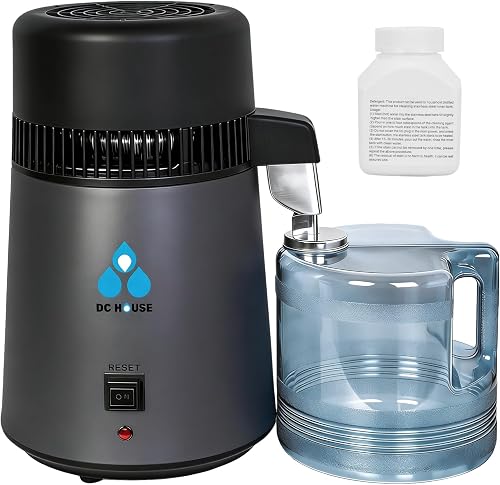
DC HOUSE 1 Gallon Water Distiller Machine: Best for humidifiers and CPAP
- 750W, 1L per hour
- 4L/1 gallon tank
- 304 stainless contact parts
- Overheat protection
A 1 gallon countertop unit for appliance water. It hits 320 F before shutting off, which protects the heater if you forget to empty the tank.
Pros
- One-touch restart after a cycle
- BPA-free pitcher with handle
- Non-slip feet
Cons
- Plastic pitcher only
DC HOUSE's 1 gallon machine is built for appliance water: humidifiers, CPAP tanks, fish tanks and coffee makers. The 750W heater makes 1L an hour and up to 6 gallons a day.
All liquid-contact parts are 304 stainless with an aluminum fan and a soft catheter to prevent leaks. The 4L BPA-free pitcher has a handle, and non-slip feet keep the unit steady on marble or glass counters.
The layout is wider and lower than the tall towers at 11.2 by 18.7 in and 10.4 in high, which helps it slide under shelves.
The safety feature to know is the 320 F shutoff, which cuts power when the tank runs dry. A one-touch reset on the front starts the next round.
DC HOUSE suggests a new carbon pack at least monthly and a citric acid clean every one or two uses if your water is hard.
It's the pick when the distiller is mainly feeding appliances rather than people. The 1 gallon pitcher is small for a family drinking several liters a day.
For larger households, the 6L VEVOR is the better fit.
ROVSUN【Upgraded】 1.1 Gallon/4L Water Distiller Stainless Steel: Best for zero plastic contact
- 750W, 1L per hour
- 4L tank
- Full 304 stainless body
- 4L shockproof glass container
A stainless body and glass carafe keep water off plastic from tank to container. The 750W heater fills the 4L jug in about 4 hours.
Pros
- All-stainless body
- Shockproof glass carafe
- Charcoal sachets and cleaning powder included
Cons
- Glass carafe needs care when carrying
This ROVSUN model takes the "no plastic" idea further than any unit here. The body, tank, inner cap, outlet and inlet are all 304 stainless, and the 4L carafe is shockproof glass with a handle.
Water touches only stainless and glass from tank to container. The 750W heater fills the carafe in about 4 hours at 1L an hour.
The built-in thermostat prevents overheating and shuts the unit off when the cycle ends. The 320 F rating matches the other 750W machines in this group.
ROVSUN includes three charcoal sachets, a soft catheter and chamber cleaning powder, and recommends cleaning the tank after every two uses. The glass carafe needs more careful handling than plastic, and it's heavier when full.
The unit itself weighs 13 lb.
Choose it if you store distilled water in the container or brew with it and want zero plastic contact. Otherwise the DC HOUSE 1 gallon costs less attention and the VEVOR pair give you more capacity per batch.
CO-Z 1.1 Gallon Water Distiller: Best for small kitchens
- 750W, 4L/1.1 gallon tank
- 304 stainless interior wall
- BPA-free plastic pitcher
- Auto-off at 302 F or low water
A compact 1.1 gallon unit for a counter that can't fit a 6L tower. The matte lid has a built-in handle for lifting and cleaning.
Pros
- Compact footprint
- Cleaning powder included
- Cooling fan and finned coils
Cons
- Smaller batches than the 1.6 gallon units
CO-Z's smaller 1.1 gallon unit fits counters where a 6L tower won't. The tank holds 4L and the 750W heater runs at 1 gallon capacity with an automatic shutoff at 302 F or when the water runs low.
The interior wall is 304 stainless at 0.03 in thick, paired with a BPA-free plastic pitcher. The matte top cover has a built-in handle, so lifting it for cleaning takes one hand.
CO-Z includes cleaning powder for sediment and limescale. The cooling fan and finned coils speed condensation, which matters when you run back-to-back batches.
The unit handles drinking water, cooking, coffee machines, humidifiers, CPAP machines and aquariums. At 18.51 by 10.63 in and 11.2 in tall, it's a low, wide shape that fits under cabinets.
Its limit is volume: 1.1 gallons means more frequent refills than the 6L machines. The 302 F shutoff is also lower than the 320 F used on the ROVSUN and DC HOUSE units.
Pick it for a small kitchen, an office or a secondary unit, and go bigger if you need more than a gallon or two a day. It's the easiest of the CO-Z line to store.
ROVSUN 1.1 Gallon Water Distiller for CPAP: Best for travel and small rooms
- 750W, 1L per hour
- 4L tank
- Fire-retardant casing
- 304 stainless tank and ports
A light 1.1 gallon distiller aimed at CPAP users and small rooms. Triple safety features and a wide mouth make daily use easy.
Pros
- Light enough to move between rooms
- Wide-mouth opening for cleaning
- Drain hose and carbon filters included
Cons
- Runs about 4 hours per 1.1 gallon batch
ROVSUN's CPAP-focused 1.1 gallon model is light and portable. It makes 1L an hour and fills its 4L tank in about 4 hours, so you can run it beside the bed or move it to the office.
The 304 stainless tank, lid and ports cover every water-contact surface, and the outer casing is fire-retardant. A wide-mouth opening makes deep cleaning quick, and the box includes a drain hose, three carbon filters (one pre-installed) and cleaning powder.
The corded electric setup means you need an outlet wherever you place it.
ROVSUN says it works for CPAP machines, humidifiers, baby formula and home labs. The triple safety setup covers overheating, fire resistance and food-grade materials.
The white finish blends into a bedroom. It shares the 9.1 by 9.1 in, 15.3 in tall frame with the other ROVSUN unit.
The trade-off is time per batch: 4 hours for 1.1 gallons is slow if you need water for a family. Pick it when the job is CPAP or a single humidifier, and choose a 6L unit when drinking water for the household is the goal.
DC HOUSE 1 Gallon Distiller: Best budget first distiller
- 750W, 1L per hour
- 4L/1.06 gallon tank
- 304 stainless contact parts
- Auto-off at 320 F
The simplest way into home distilling: a 1 gallon tank, one button and a stainless liner. It covers basic drinking and appliance water at the lowest entry point here.
Pros
- Simple one-button start
- Large opening for cleaning
- BPA-free pitcher with handle
Cons
- Older design than the DC HOUSE 1 gallon above
DC HOUSE's older 1 gallon distiller is the simplest entry point. The 750W heater makes 1L an hour and up to 6 gallons a day, and all liquid-contact parts are 304 stainless.
The 4L BPA-free pitcher has a handle, and the aluminum fan and soft catheter keep the unit running without leaks. One button starts it, and the 320 F thermostat shuts it off to prevent overheating.
It's low-noise and easy to clean with the included powder. The body measures 10.4 by 11.2 in and stands 18.7 in tall.
DC HOUSE suggests a new carbon pack weekly and a citric acid clean after every two uses. The large-opening liner makes that quick.
It handles coffee machines, humidifiers, engine cooling systems and drinking water. The 1L per hour rate and 6 gallon daily ceiling match the newer DC HOUSE model.
Against the newer DC HOUSE model above, this one is a step behind on design but covers the same basics. Pick it if you want the lowest-cost way to start distilling.
Skip it if you want the largest batches or a glass container.
How these home distiller machines compare
The comparison table lines up tank size, heater wattage and container material, which are the three specs that decide how a distiller fits your routine.
| Product | Best for | Capacity | Power | Material | Our score |
|---|---|---|---|---|---|
| VEVOR Water Distiller | large daily batches | 6 liters | 900W | 304 stainless steel | 9.7 |
| VEVOR Water Distiller | glass container fans | 1.6 gallons | 900W | 304 stainless steel | 9.6 |
| CO-Z 6L Water Distiller | cleaning supplies included | 1.6 gallons | 900W | Stainless steel | 9.3 |
| ROVSUN Upgraded 1.1 Gallon/4L Water Distiller Countertop | overnight running | 4 liters | 750W | Stainless steel | 8.8 |
| DC HOUSE 1 Gallon Water Distiller Machine | humidifiers and CPAP | 1 gallons | 750W | Stainless steel | 8.8 |
| ROVSUN【Upgraded】 1.1 Gallon/4L Water Distiller Stainless Steel | zero plastic contact | 4 liters | 750W | Stainless steel | 8.3 |
| CO-Z 1.1 Gallon Water Distiller | small kitchens | 1.1 gallons | 750W | 304 stainless steel | 8.1 |
| ROVSUN 1.1 Gallon Water Distiller for CPAP | travel and small rooms | 1.1 gallons | 750W | 304 stainless steel | 8.0 |
| DC HOUSE 1 Gallon Distiller | budget first distiller | 4 liters | 750W | Stainless steel | 7.5 |
Our score weighs specs, features and buyer feedback against what you're shopping for. Tank size and hourly output carry the most weight, since they decide how often you refill.
Container material, included cleaning supplies and safety shutoffs separate the close calls.
The 6L machines score highest because they cut refills to once a day for most households. The 4L machines land lower because they need two rounds to match that output, even though they're quieter and lighter.
The two 900W VEVOR models differ by only a tenth of a point, since the tank and heater are identical and the pitcher is the whole story.
Which size distiller do you need for daily drinking water?
A 1.6 gallon (6L) tank is the right size for most households that drink distilled water daily. A 4L tank suits one or two people or appliance water.
Pick by how many liters you actually go through in a day, not by how big the machine looks.
A family of four drinking 2L each needs about 8L a day. That's more than two full cycles on a 4L machine and less than two on a 6L unit.
If you also use distilled water for coffee, cooking and pets, go straight to 6L.
The 6L machines
The VEVOR pair and the CO-Z 6L hold 1.6 gallons and make over 1.3L an hour at 900W. One full tank covers most of a family's daily water in a single cycle.
These are the machines to choose when you want to fill once and forget it. All three top out near 31.2L a day.
The 4L machines
The ROVSUN and DC HOUSE units hold about 1 gallon and run at 1L an hour. They suit a couple, a CPAP user or a household that only distills water for appliances.
Plan on a second cycle when you need more than a gallon. The 1.1 gallon units sit in the same bracket with slightly less headroom.
Glass or plastic container: which is better on a distiller?
Glass is the better choice if you store distilled water in the pitcher or brew with it. Plastic is lighter and easier to carry.
Both VEVOR models use the same 304 stainless tank, so the container is the only difference that matters.
Glass doesn't hold odors and stays clear, and the ROVSUN glass model keeps water off plastic entirely. The downside is weight and breakage risk.
A full 4L glass carafe is heavy, and it needs careful handling when you carry it to the fridge. The borosilicate glass on the VEVOR model handles heat better than ordinary glass.
Plastic pitchers are lighter and cheaper to replace. The food-grade PBT and BPA-free plastic on the VEVOR and DC HOUSE units is fine for water you'll use within a day.
If the pitcher lives on the counter and gets refilled often, plastic is the practical pick.
When glass is worth it
Choose glass if the water sits in the pitcher overnight or you're sensitive to plastic taste. The VEVOR glass version and the ROVSUN stainless model are the two glass options here.
Both keep the collected water off plastic until you pour it.
When plastic makes more sense
Choose plastic if the pitcher moves a lot or kids use it. The top VEVOR pick and both DC HOUSE units use food-grade plastic containers that are lighter and tougher.
They also cost less to replace if one cracks.
How much does it cost to run a countertop distiller?
Running a distiller costs about 3 kWh per gallon at 750W. A 900W machine uses about 3.6 kWh for the same gallon.
At a typical US electricity rate that's a few cents to a few dimes per gallon, well under bottled water prices.
The math is simple: watts times hours. A 750W unit running 4 hours for a gallon draws 3 kWh.
The VEVOR 900W units make a gallon in about 3 hours, so they land near the same total. Faster heating doesn't mean much more energy per gallon.
The bigger cost over a year is cleaning supplies and carbon packs. VEVOR and CO-Z include a starter set.
Budget for citric acid and replacement carbon if you distill daily, and clean on schedule so scale doesn't cut output. A scaled heater has to work longer for the same gallon, which quietly raises the power cost.
What to check before you buy a home water distiller machine
Check three things before you order: the tank size against your daily use, the container material, and whether the unit shuts off on its own. Everything else is convenience.
Tank size decides refill frequency. Heater wattage decides speed: 900W units beat 750W units by about a third.
Container material decides how the water tastes after a day in the pitcher. Auto-shutoff decides whether you can run it overnight or while you're out.
Also check the cleaning routine the brand recommends. ROVSUN suggests cleaning after two uses, DC HOUSE after one or two.
Machines with wide openings and included cleaning powder are easier to keep in shape. For the full routine, our cleaning guide walks through the citric acid soak step by step.
Fit and counter space
The VEVOR units stand 19.69 in tall and take an 11.81 in square of counter. The CO-Z 1.1 gallon unit is shorter and easier to tuck under a cabinet.
Measure your counter and the space above it before choosing a tower. A distiller also needs clear space around the fan and exhaust cover, so leave a gap at the sides and top.
Water quality and TDS
CO-Z rates its distiller for source water up to 500 ppm TDS. Very hard water leaves scale faster on every machine, so check your tap water's hardness.
If it's high, plan on more frequent cleaning or run softened water through the distiller. Scale on the tank bottom is the first sign you've waited too long.
Verdict: the best home water distiller machine for most homes
The VEVOR 6L/1.6 Gallon is the best home water distiller machine for most people. It makes up to 31.2L a day from a 6L tank, heats at 900W and keeps water in a food-grade plastic pitcher.
Pick it and you fill once a day, clean every couple of weeks and stop buying bottled water.
Choose the VEVOR glass version if you want the pitcher to be glass. Take the CO-Z 6L when you'd rather have cleaning supplies in the box.
Go with a 4L unit like the DC HOUSE 1 gallon for CPAP and humidifier water, or the ROVSUN stainless model for zero plastic contact.
Whatever you buy, set a cleaning schedule from day one. Our guide on how to clean a water distiller covers the citric acid soak that keeps output high, and the countertop distiller roundup has more models if none of these fit your counter.
Our top 3 picks at a glance
-
1
-
2
-
3
Frequently asked questions
How long does a home distiller take to make a gallon of water?
Most 750W models here produce about 1L an hour, so a gallon takes roughly 4 hours. The 900W VEVOR units run faster at over 1.3L an hour, which cuts a gallon to about 3 hours.
Do I need to clean a distiller after every batch?
No. ROVSUN suggests cleaning the tank after every two uses, while DC HOUSE says every one or two uses.
Hard water leaves scale faster, so check the tank bottom after each cycle and clean sooner if you see white buildup.
Can I use distilled water for baby formula?
Yes, distilled water is commonly used to mix formula because the boiling and condensing process removes minerals and most contaminants. Follow your pediatrician's advice on water for infant feeding, and let the water cool before mixing.
Does a water distiller remove fluoride?
Yes. Distillation boils water into steam and condenses it, leaving fluoride and most dissolved minerals behind in the tank.
That is why distillers suit people who want mineral-free water.
How much electricity does a countertop distiller use?
A 750W unit draws about 0.75 kWh for every hour it runs. At about 4 hours per gallon, expect roughly 3 kWh per gallon, so running one daily adds a noticeable but modest amount to a power bill.
What water can I put into a distiller?
Use tap water. CO-Z rates its distiller for water up to 500 ppm TDS.
Very hard water scales faster and needs more frequent cleaning, while softened water is gentler on the tank.


